 trending











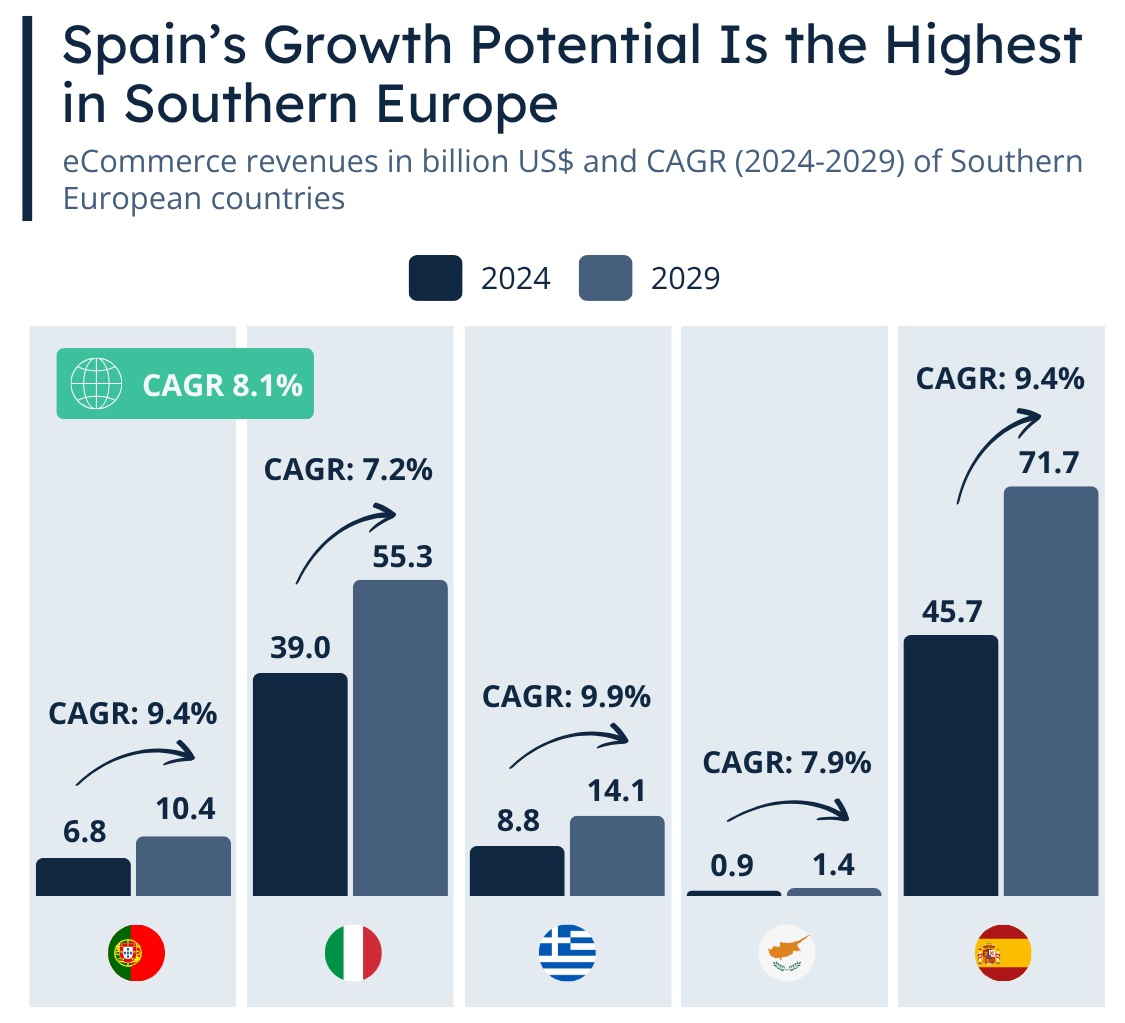
Southern Europe’s e-commerce sector is entering a period of unexpected dynamism, with Spain, Portugal and Greece all forecast to exceed global average growth rates through to 2029.
According to data from ECDB, these markets are poised to outperform the worldwide e-commerce compound annual growth rate (CAGR) of 8.1%, with Greece leading at 9.9%, followed closely by Spain and Portugal at 9.4%.
While it is often the continent’s larger northern economies – such as Germany, France and the UK – that dominate the European e-commerce narrative, the latest figures suggest a recalibration may be underway.
This southern surge reflects not just the mathematical advantage of growing from a smaller base, but also a convergence of international and domestic factors catalysing structural change.
International Marketplaces Fuel Ascent
 One of the most significant drivers of this acceleration is the penetration of low-cost international platforms – such as TikTok Shop, AliExpress and Temu – which have rapidly gained traction across these markets.
Spain was one of TikTok Shop’s European launchpads, and all three platforms now rank among the top five in each of the three countries.
These platforms’ appeal lies in their deep discounting, expansive assortments, and agile app-based ecosystems.
In economies grappling with stagnant wages and the lingering effects of financial crises, such models have proved especially resonant.
They have not only captured consumer interest but also stimulated broader adoption of online retail in historically under-digitised markets.
Domestic Champions
However, this growth is not wholly dependent on foreign players.
In Spain and Portugal, legacy retailers like Inditex and El Corte Inglés are actively shaping the digital retail landscape.
El Corte Inglés, notably partnered with Alibaba since 2018, has leveraged its logistics footprint and brand equity to retain relevance in an increasingly internationalised market.
Greece, absent its own Amazon domain, presents a distinctive case.
The market is dominated by local champions such as Skroutz, Public, and regional grocery platforms.
Their success underscores the viability of regional adaptation in lieu of global standardisation.
While more resource-intensive to develop, this domestically rooted model promises more sustainable long-term growth.
Elsewhere in Southern Europe…
Not all Southern European markets are poised for takeoff. Cyprus, constrained by geopolitical complexity and limited logistical access as an island state, is forecast to grow below the global average at 7.9%.
Italy, despite its scale, faces structural challenges – particularly demographic pressures and entrenched consumer preferences for offline retail – that dampen its projected CAGR to 7.2%.
As Southern Europe increasingly becomes a focus for e-commerce expansion, payments providers and digital platforms alike would do well to re-evaluate their regional strategies.
The convergence of international marketplace activity and homegrown innovation is reshaping what were once peripheral markets into credible growth engines for the decade ahead.






Comments