 trending











Britain’s long-anticipated shift towards a cashless economy continues to look overstated.
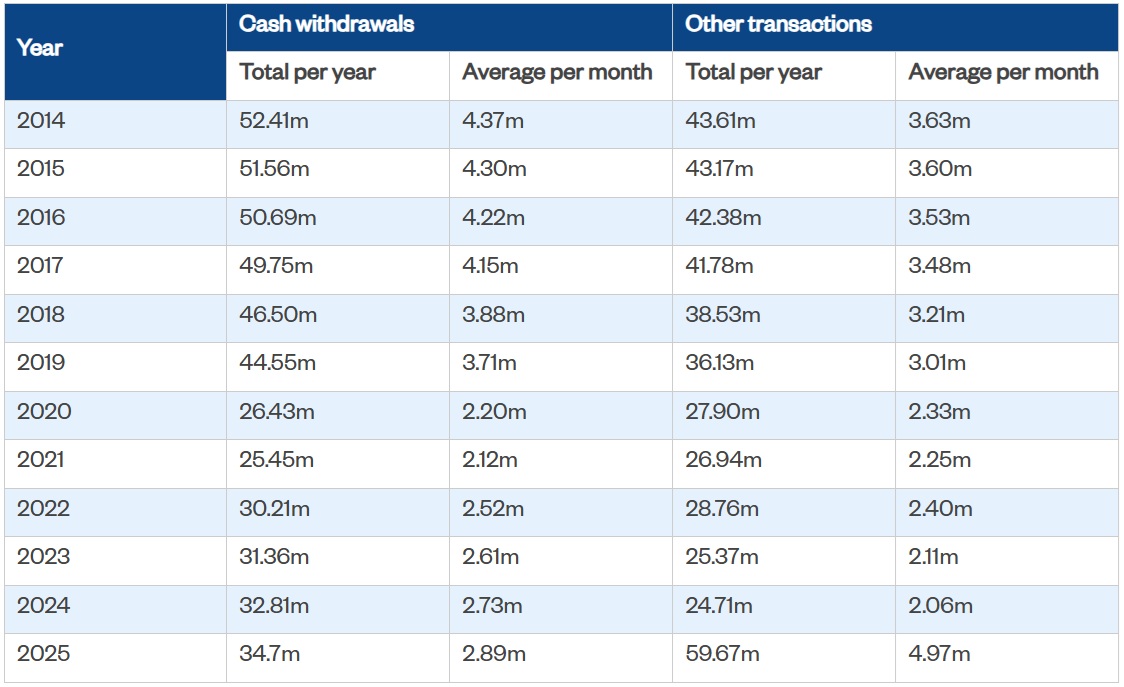
New figures from Nationwide Building Society show that cash usage rose for a fourth consecutive year in 2025, with ATM withdrawals reaching a record £4.2bn.
The total surpasses the previous peak of £4bn recorded in 2017 and underlines the persistent role of physical money in an increasingly digital payments landscape.
Cash Withdrawals Continue to Climb
Nationwide recorded approximately 34.7 million cash withdrawals across the 1,270 ATMs located in its 605 branches during 2025, an increase of around six per cent on the previous year.
The average withdrawal value also rose, from £113 in 2024 to £120 in 2025, suggesting that consumers are relying on cash not merely for convenience, but as a deliberate financial tool.
Demand was particularly pronounced during peak spending periods. In the week before Christmas, £103m was withdrawn — the highest weekly total since before the pandemic and a five per cent increase year on year.
The week leading up to Black Friday also saw heightened activity, with withdrawals up nine per cent, indicating that cash continues to play a role in budgeting during periods of intensified consumer expenditure.
Cost-of-Living Pressures and Spending Control
Nationwide’s own research points to a behavioural explanation behind the trend.
Thirteen per cent of Britons — equivalent to around seven million people — say paying in cash makes it easier to save. In an environment of prolonged cost-of-living pressures, cash offers a tangible sense of control that digital payments often lack.
For many households, physical money acts as a constraint on discretionary spending rather than an inconvenience.
This runs counter to the assumption that convenience alone drives payment choice. While contactless and mobile payments dominate transaction volumes, cash retains a psychological utility that continues to resonate with a meaningful segment of consumers.
Branch Closures Reshape Cash Access
The rise in withdrawals comes amid the continued contraction of the UK’s bank branch network.
According to Which?, more than 6,600 branches have closed since 2015, eliminating roughly two-thirds of the network that existed a decade ago. As a result, remaining branch-based ATMs are increasingly serving wider communities.
ATMs as Multi-Purpose Banking Infrastructure
Cash withdrawals are no longer the sole function of branch ATMs. More than 40 per cent of Nationwide ATM transactions now relate to services such as bill payments, PIN changes, and cash and cheque deposits.
While the average cash deposit edged up to £281, overall deposited volumes remain below their 2022 peak, reflecting broader changes in consumer and small-business cash usage.
The data suggests that, despite the advance of digital payments, cash remains a vital component of financial inclusion, budgeting discipline and community banking — and is unlikely to disappear any time soon.





Comments