 trending











Payment systems have become the nervous system of the consumer economy. Every transaction at a supermarket checkout, hotel reception, or café till depends on complex networks of hardware, software, and connectivity.
 But what happens when they fail, the consequences are immediate and costly.
New payment resilience research into the UK and French markets by FreedomPay shows just how fragile this infrastructure has become – and how businesses risk billions in lost sales and reputational damage when payments stop working.
Billions at Stake
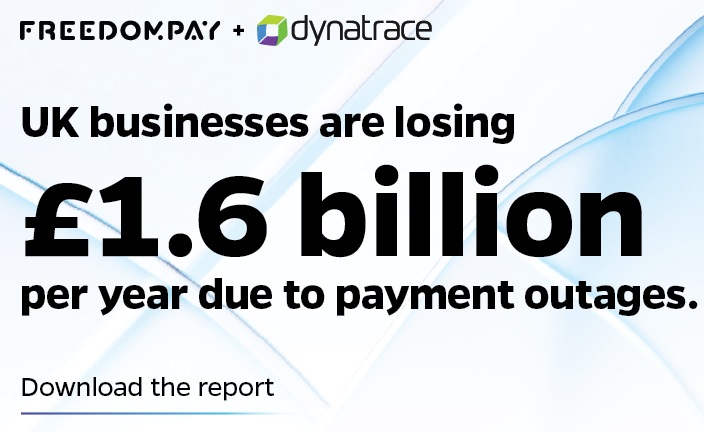
Across the UK, failures in payment systems are estimated to put £1.6 billion in annual sales at risk. In France, the figure rises to €1.9 billion.
These are not theoretical losses: retailers and hospitality operators report around five major outages each year, according to Retail Economics, an independent economics research consultancy, who conducted both sets of research.
Strikingly, most occur during peak trading, when footfall and pressure on systems are at their highest.
The financial exposure is amplified by interdependence. A single failure – whether at the card machine, network level, or power supply – can cascade across mobile ordering, cloud-based tills, and loyalty platforms.
What begins as a technical glitch quickly becomes a full-scale operational breakdown.
“What the research shows in France really underscores how fragile the payments ecosystem can be if it isn’t modernised,” explains Chris Kronenthal, President of FreedomPay.
“When you see outages at that scale, it disrupts not only merchants but also consumers who are depending on fast, seamless transactions.
This is why at FreedomPay we emphasise resiliency and redundancy in the payment infrastructure.
Retailers need solutions that don’t just process payments in the good times but are also reliable when things go wrong. Outages like this can cost millions in lost sales and erode consumer trust very quickly.
At the end of the day, payment is the heartbeat of commerce. If it fails, everything else fails with it. That’s why modernisation, flexibility, and having backup systems in place is so critical.”
The Patience Gap
The most sobering finding is the mismatch between consumer patience and outage duration.
In both markets, shoppers will tolerate no more than seven minutes of disruption before frustration sets in. By 12–23 minutes, most abandon the transaction altogether. Beyond 24 minutes, many vow never to return.
Yet average outages last 72 minutes in France and 84 minutes in the UK – more than four times longer than customers are willing to wait.
Businesses often assume shoppers will tolerate half an hour or more, but this optimism is misplaced.
The reality is stark: by the time systems are restored, the majority of customers have already walked away, and many have taken their grievances online with social media the favoured conduit.
Losses Accelerate Rapidly
Both studies highlight how losses escalate sharply in the early minutes of a failure. In France, 79% of total losses occur within 23 minutes. In the UK, 74% of losses accrue within the first 22 minutes.
This front-loaded pattern underscores why resilience planning cannot rely on slow recovery. If payments are not restored almost instantly, the bulk of the financial hit is unavoidable.
The Decline of Cash Safety Nets
Historically, businesses could fall back on cash when digital systems faltered. But that safety net has frayed.
In Britain, fewer than 30% of consumers carry cash, and younger shoppers are least likely to do so. Even when cash is available, the average amount (£35) falls short of the typical in-store spend (£47).
France is slightly better insulated, with 32% of consumers regularly carrying cash, but the shortfall remains: the average €40 in wallets does not cover the €55 average transaction.
This reliance on digital methods means outages now leave many consumers unable to complete purchases at all.
The groups most dependent on cards and mobile wallets – affluent, frequent spenders – are also those most exposed when systems fail.
Rising Reputational and Human Costs
The damage is not just financial. In France, nearly 70% of managers have faced verbal abuse from customers during outages, and one in ten have reported physical aggression.
Younger consumers, in particular, are quick to hold businesses directly responsible and to broadcast complaints on social media.
In the UK, businesses themselves acknowledge that trust is at risk. More than half say their greatest concern during an outage is reputational rather than purely financial.
With one in three consumers stating that a single payment failure reduces their trust in a brand, these fears are well founded.
Patchwork Fixes Are Not Enough
Many businesses are trying to prepare, but coverage remains inconsistent. In Britain, one in five firms has no backup method beyond cash, and 7% have no fall back at all.
France is even more exposed, with 43% of firms lacking dependable digital backups.
Where solutions exist, they are piecemeal. Secondary internet lines, offline card processing, and mobile QR-based checkouts are being adopted, but rarely in combination.
This fragmented approach leaves gaps, especially during high-footfall events when resilience matters most.
Towards Intelligent Resilience
The lesson across both markets is clear: resilience cannot mean simply waiting for systems to recover. Businesses need intelligent, integrated solutions that detect failures early, isolate faults, and switch seamlessly to backups before customers notice.
In practice, this means investing in infrastructure that can sustain payments under stress – from robust connectivity and power redundancy to offline card authorisation and digital alternatives.
It also requires rethinking customer communication, ensuring transparency during disruptions to protect trust even when systems falter.
So, What Can be Done?
Payment disruption is no longer a rare inconvenience but a systemic operational risk. Across the UK and France, retailers and hospitality providers are losing billions each year, much of it within the first 20 minutes of an outage.
As digital dependency deepens and cash recedes, the stakes have never been higher.
For businesses, resilience is now a competitive differentiator. Those that can guarantee seamless transactions – even under strain – will not only protect revenues but also safeguard the trust that underpins long-term customer loyalty.
In an era where minutes can erase millions, intelligent resilience has become nothing less than a business imperative, or as Kronenthal, was keen to remind me “offline resilience should be table stakes.”
To download either the French or UK reports CLICK HERE





Comments