 trending











Nordic countries continue to lead the world in their adoption of cashless payment methods, according to a new Nordic Payments Report.
Cash use in the Nordics is the lowest in the world, with almost a third of Nordic consumers indicating they now never pay with cash in physical sales locations.
Consumer payment preferences in physical stores have changed in recent years. Comparing today’s payment methods with those from just five years ago, the use of cash has dropped drastically and continues to decline.
However, the report believes that the level will soon reach its bottom and will not decrease further.
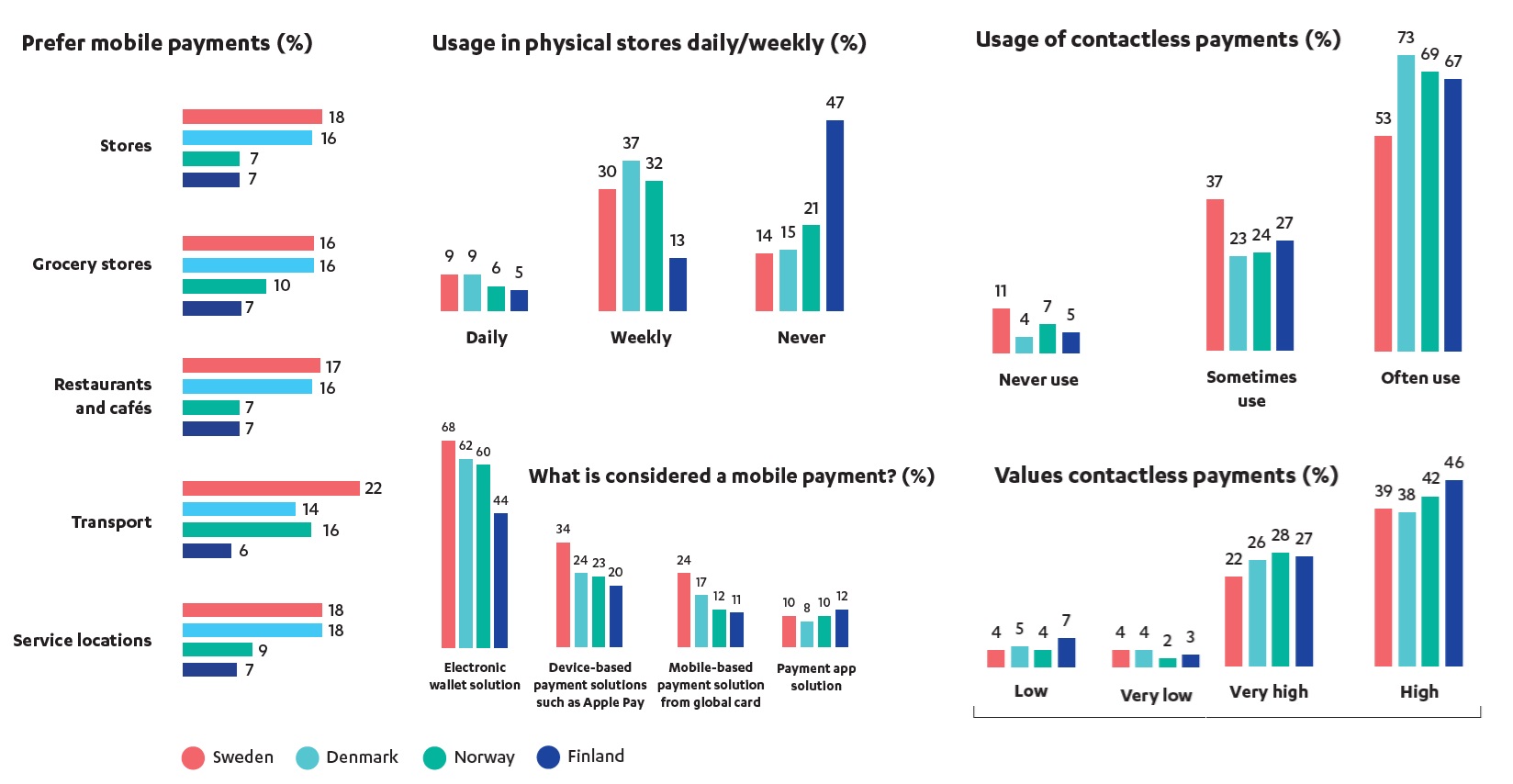
Across the Nordics, mobile payments have now overtaken cash as the second most preferred payment method, behind card payments.
Contactless capabilities are the major driving force behind this transformation, with consumers favouring their convenience and security over alternatives such as cash or QR Code-based mobile payment solutions.
Payment cards still dominate as the Nordic region’s preferred payment method, but the report notes a gradual decrease in usage.
This decline is due to the significant increase in the use of mobile payments, which is now the second most popular payment method in almost all Nordic countries. This trend is expected to continue.
Most mobile payments are card-based, but according to the survey, mobile payments are seen as an independent payment method.
In Norway, Vipps and Apple Pay dominate, Swish is mostly used in Sweden, and MobilePay is preferred by Danes.
Even in Finland, where cash usage has significantly decreased and is getting closer to the levels in the other Nordic countries, mobile payments are nearly at the same level as cash.
Regarding contactless payments, which include both card and card-based mobile payments, there is a continued increase in usage.
“We’ve carried physical wallets for centuries,” said Lars Erik Tellmann, Chief Regional Officer for Nexi in the Nordics.
“Taking cash, cards, receipts, and photos of loved ones with us everywhere. Nowadays, Nordic consumers want to use their mobile phone as this wallet, carrying the same things with them but in digital form.
Contactless provides a seamless and secure payment experience for consumers, while facilitating newer payment methods like SoftPOS, which are set to transform physical commerce experiences in the coming years.”
Convenience increases contactless payments
The contactless payment limit without requiring PIN increased to €50 in 2019. Since then, the share of payments made via the technology has grown, accelerated by the pandemic.
From 1 January 2024, Finland will also adopt the same technical setup as its neighbours, requiring just PIN (rather than a contact payment) for transactions above this level.
Combined with a significant increase in payments made via mobile wallets, such as Apple Pay and Google Pay, Nexi expects to see the proportion of contactless payments made in the Nordics grow further next year.
In Denmark, 96% of consumers use contactless payments, and a potentially world-leading 94% of card payments are now made contactlessly.
In Sweden, this is 89% and 86% respectively, while Norway and Finland also show high adoption.
Overall, nine in ten Nordic consumers use contactless payments, with seven out of ten consumers in Denmark, Norway and Finland using it ‘often’.
Key Findings:
- Almost one in two Swedes never pay in cash (in Norway this is 40%, Denmark 27% and Finland only 10%, although the Finnish rejection of cash is accelerating).
- Mobile payments continue to grow, becoming the preferred method of about a fifth of Danish and Swedish consumers.
- Apple Pay now contributes a significant share of all digital payments in Denmark and Sweden, but local brands including Sweden’s Swish, Norway’s Vipps and Denmark’s MobilePay retain strong use among consumers.
For more Nordic Payments Statistics CLICK HERE




Comments