 trending











The U.S. Faster Payments Council (FPC) has released its 2025 US Instant Payments Adoption Quantitative Study, providing one of the clearest signals yet that real-time payments are moving from promise to practice across America’s financial system.
Surveying third-party enablers that collectively serve more than 90 per cent of US financial institutions, the study charts how adoption is accelerating, which use cases are taking the lead, and where the biggest challenges remain.
Shifting from early adoption to scale
In its 2024 analysis, the FPC projected that by 2028 up to 80 per cent of institutions would be able to receive instant payments, with around 30–40 per cent offering the ability to send.
That forecast is now being fleshed out with more detail on the factors shaping adoption.
A critical finding is that institutions typically take 12–18 months to transition from “receive-only” capability to enabling outbound instant credits, underscoring the importance of ongoing investment in supporting infrastructure.
Use cases driving real-world traction
Earned wage access, wallet funding, peer-to-peer transfers, and marketplace or gaming payouts remain the most visible drivers of growth.
In 2025, loan disbursements – from auto finance to real estate – have emerged as an additional catalyst, highlighting how instant payments are gaining traction in higher-value transactions.
These use cases are attractive because they address tangible needs: quicker access to wages, instant settlement of winnings, or faster loan funding that improves customer experience.
Technology priorities: fraud, user interfaces and QR codes
The study underscores that adoption will depend as much on trust and usability as on speed.
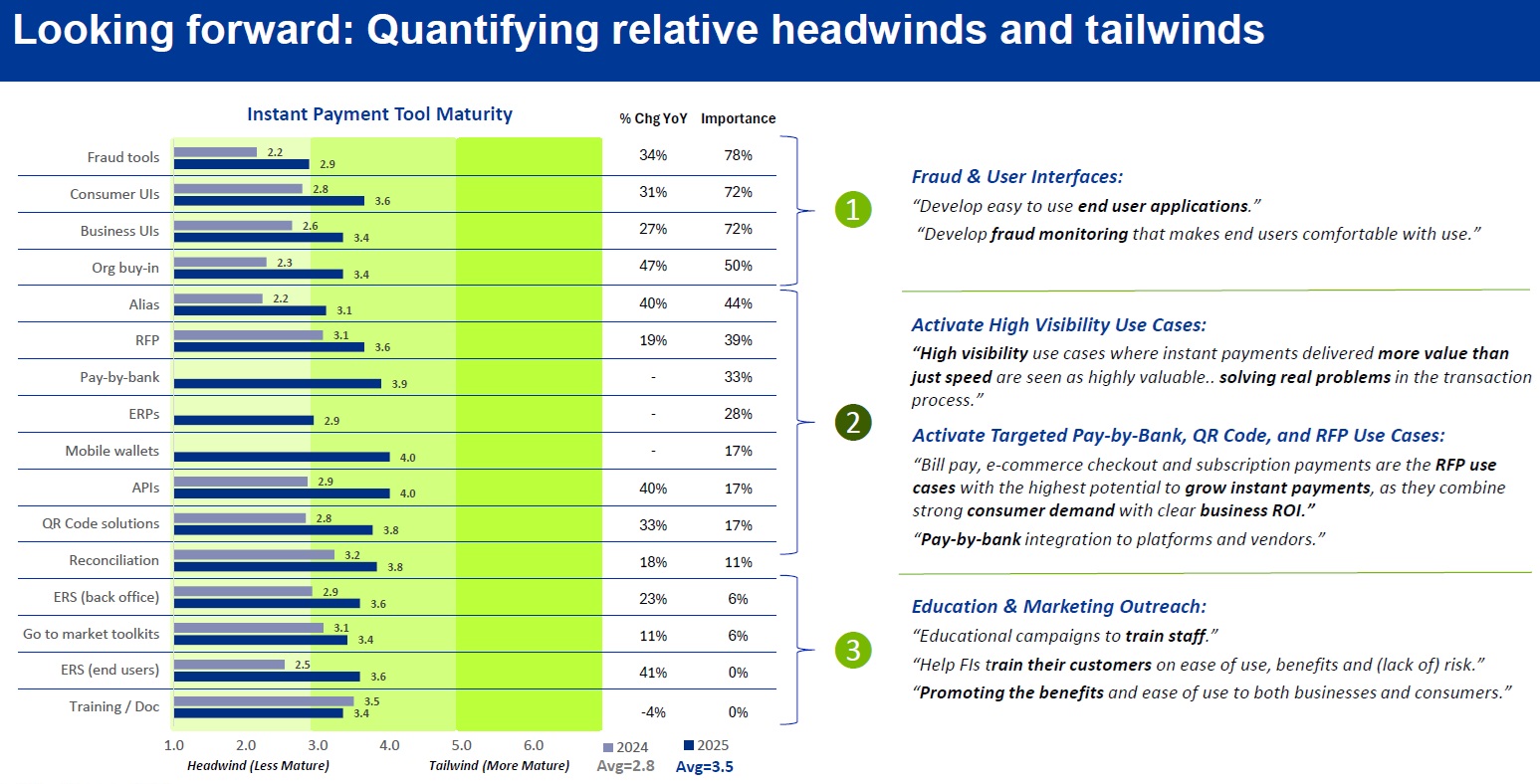
Fraud mitigation tools were cited by 78 per cent of respondents as a critical priority, while both consumer and business-facing interfaces scored 72 per cent.
Respondents also pointed to QR codes, APIs, and “pay by bank” functionality as key enablers of adoption, bridging the gap between institutional readiness and everyday usage.
Standards and industry collaboration
Standards are seen as another essential step to scaling adoption. Fraud prevention, user interfaces, and handling exceptions ranked as top areas for industry-wide harmonisation.
Respondents also called for greater education and marketing efforts to build user confidence and highlight the benefits beyond speed – such as improved reconciliation and reduced chargebacks for businesses.
With earned wage access and consumer wallets leading the charge, and B2B payments poised to follow, instant payments are increasingly woven into the fabric of US commerce.
Yet, as the FPC emphasises, the journey is far from complete. Addressing fraud, building intuitive user experiences, and aligning standards will determine how quickly instant payments can become not just an option, but the default.




Comments