 trending




As part of new series on high-growth Asian markets outside China, James Wood looks at Thailand, asking what’s next for a country that’s seen P2P and digital wallet payments soar.
Since the 1960s, Thailand has been known in the West for its culture and tourism, from white sand beaches to street food and Buddhist temples.
However, such beauty and history mask an economic dynamism that has distinguished the country for decades now.
While growth has dipped into recession on three occasions since the 1970s, it’s typically hovered at around 5 percent per year, putting Thailand on a par with other fast-growing Asian economies such as Vietnam and the Philippines.
“More Thais are unbanked than in many African markets – but mobile is plugging the gap.”
Such economic dynamism isn’t always reflected in the formal economy, however: fewer than one in 12 Thais has a credit card, for instance, while cash is still used in preference to cards for two-thirds of in-person payments and more than a third of online payments.
In part, this is because Thailand remains something of a laggard when it comes to bank accounts: formal bank accounts aren’t easy to open, while almost half the population remains either “underbanked” or “unbanked”, according to BanqIn – a higher proportion than in most African markets.
Going mobile – for benefit and risk…
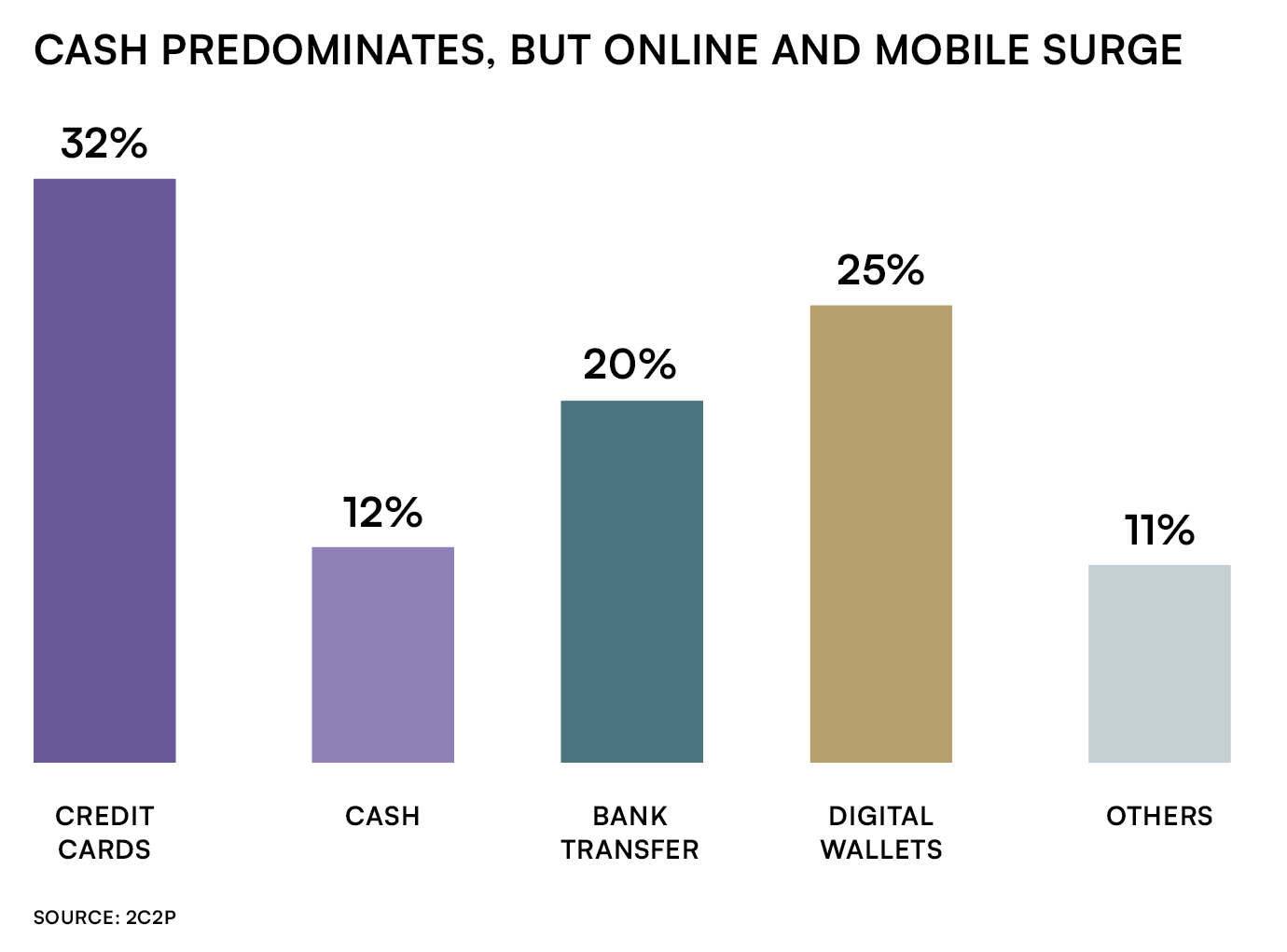 In a pattern familiar to those who know developing markets, mobile operators – encouraged by the Bank of Thailand – have stepped in to fill the gap between bank offerings and market demand for faster electronic payments.
For starters, smartphone penetration in Thailand is off the charts at 133% – meaning there are three times more smartphones than bank accounts in the country.
According to Mordor Intelligence, e-wallet usage will grow around 14 percent per year over the next decade, while just one provider, TrueMoney, reports consumer usage grew by 200 percent in the last year alone.
“With three times more smart phones than bank accounts in Thailand, one e-wallet claimed to grow 200% in 2021.”
If peer-to-peer payments are spiking, then online shopping is no less buoyant, with Adyen reporting digital payments are growing by a third every year. Foreign players smell opportunity, and both Japan’s Line Pay as well as Chinese giants WeChat and AliPay are moving into the market.
Such stories of growth – however positive they sound – inevitably create regulatory headaches and raise questions about the future role of retail banks in Thailand.
How to prevent fraud by introducing better electronic Know Your Customer (eKYC) routines is a pressing question for regulators – as is protecting the systemic position of banks in payments.
In common with other emerging markets, it’s all well and good to allow tech players and telcos to flourish – provided you give banks the same opportunities, and protect your citizens from fraud.
Regulator making moves at home and abroad
The Bank of Thailand has been far from idle in the face of these challenges. Aside from supporting the advent of telecom companies and tech players, the Bank has also taken steps to standardise the country’s payment architecture with those of Malaysia and Indonesia, making cross-border payments for business easier.
On the domestic front, the Bank of Thailand introduced an instant payments system – PromptPay – in 2016 with the goal of driving electronic payments and giving consumers more payment options in a controlled, regulated environment.
Now used by around two-thirds of Thais, this system enables P2P and business payments using citizen IDs, mobile phone numbers and bank accounts.
Sending the payments via digital channels means much lower fees compared to traditional card transactions – an important point in emerging markets, where high fees charged by banks can stymie entry to the formal economy.
The Thai government has encouraged PromptPay usage by making social welfare payments using the system, as well as other government services from housing to healthcare.
Most recently, PromptPay has enabled QR-code payments for further ease of use.
While we’re often slow to praise at Payments Cards & Mobile, PromptPay seems to be remarkably successful, with 14.8 billion transactions recorded in 2022. That’s 48 percent growth more than in 2021 – and a whopping 213 transactions for every Thai citizen.
Into Thai future: the first government Super App?
When it comes to the art of prediction, there are obvious things anyone could tell you about Thai payments, in common with its emerging Asian peers.
E-commerce will keep growing fast, as will electronic payments – especially account-to-account payments and request to pay, powered by PromptPay.
“High tourist numbers mean cards and e-wallets will grow. But PromptPay could be something truly special.”
We’ll also see serious competition to cash come from Japan’s Line Pay and China’s WeChat and AliPay.
Given that there are almost as many tourists (60m) resident in Thailand at any given time as there are Thais, no doubt card payment and digital wallets will also surge as cash use declines. So far, so simple to predict.
After that, the status of PromptPay and its runaway success poses an intriguing question. Could it become the world’s first government Super App?
Damian Gough, Head of Asia Pacific at issuer/processer specialists Thredd (formerly GPS) thinks so: “PromptPay has been a great tool for financial inclusion. The pricing is competitive, and the addition of social payments has enhanced its popularity.”
In some ways, we’ve seen parts of this happen elsewhere: in Europe, NemID and BankID are used for payments, welfare and benefits, and digital ID, while the Chinese Super Apps are powered by their link to a government-mandated digital ID.
However, Thailand appears to be the only country so far to have successfully combined multiple payment options, ID, access to government services and welfare payments in one place – not to mention the option to pay from a bank account or top up an e-wallet with cash.
As competition hots up in Super Apps, it could be that a beautiful land of beaches and temples has much to teach us all.



Comments