 trending











The narrative of online retail is often dominated by success stories: platforms scaling at speed, new entrants disrupting incumbents, and established players adapting to digital-first consumer behaviour.
Yet for every rising star, there is a counterpart in decline.
Recent analysis of global e-commerce performance reveals which retailers are losing ground, and why their struggles matter in a marketplace defined by fierce competition and unforgiving margins.
Identifying Underperformance in E-Commerce
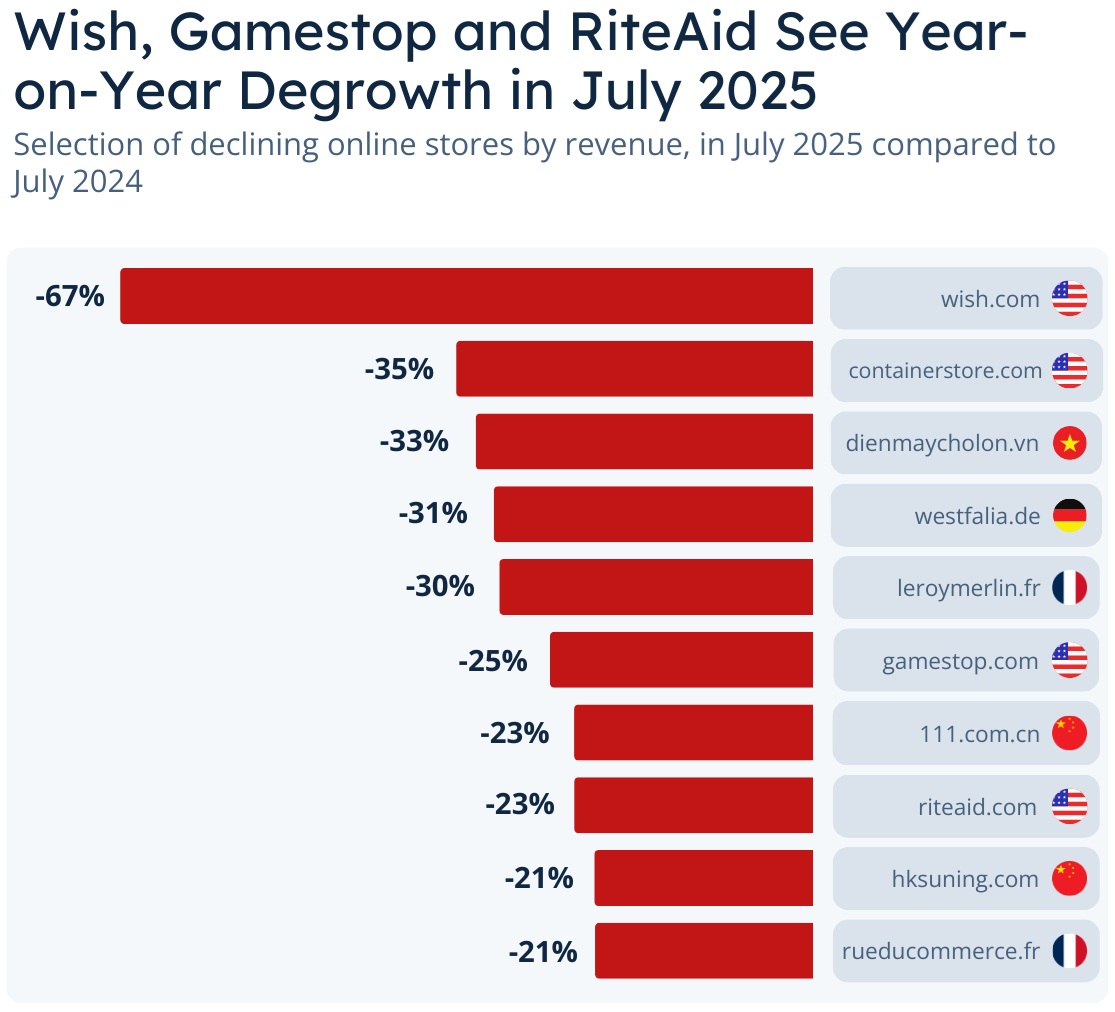 To ensure statistical reliability, the analysis focuses only on retailers generating more than $50 million in annual revenue.
By examining monthly data rather than waiting for quarterly or annual disclosures, it is possible to see performance shifts in real time.
Temporary setbacks, such as store closures or cyber breaches, are excluded so that the picture reflects structural challenges rather than short-term shocks.
US Retailers: From Wish to Rite Aid
The United States, the world’s second-largest e-commerce market, unsurprisingly features heavily among underperformers.
Wish.com, once a poster child for discount e-commerce, recorded a dramatic 67% year-on-year sales decline.
The model of selling ultra-cheap goods has lost traction as rivals such as Temu, TikTok Shop and AliExpress replicate the approach with greater scale and sharper logistics.
The Container Store’s digital operations are also suffering, following bankruptcy proceedings in 2024. While restructuring is under way, weak demand and entrenched competition from both marketplaces and big-box retailers suggest the online channel may struggle to recover.
GameStop and Rite Aid face sector-specific headwinds.
GameStop, despite its infamous stock market saga, has failed to reinvent itself as physical game sales decline.
Rite Aid, meanwhile, remains constrained by debt and squeezed by the dominance of national pharmacy chains with stronger omnichannel propositions.
European Weak Spots: Westfalia, Leroy Merlin
Europe presents a different set of challenges, rooted in structural inefficiencies and customer dissatisfaction.
Westfalia, a German tool retailer, has faced bankruptcy and is battling to re-establish its online presence in a highly saturated DIY market. With Amazon and other marketplaces undercutting on price, differentiation is limited.
In France, both Leroy Merlin and Rue du Commerce have been hit by operational missteps.
Poor customer experiences have dented loyalty, proving that even in highly competitive environments, basic execution on service quality remains decisive for retention.
China’s Smaller Platforms Struggle for Scale
China offers perhaps the starkest reminder of the risks of competing against market behemoths.
Once-promising sites such as 111.com.cn in pharmaceuticals and hksuning.com in general retail are being squeezed by giants like JD Health, Alibaba Health and Pinduoduo.
With scale dictating both price and margin, smaller players are left with shrinking market share and little room to manoeuvre.
A Widening Gap in Global E-Commerce
Taken together, these examples highlight a widening gulf in global e-commerce.
Retailers that fail to invest in technology, customer experience, and strategic differentiation risk rapid decline.
Those unable to match the logistics sophistication of Temu or the ecosystem dominance of Amazon and Alibaba are losing relevance.
The lesson for payments and retail strategists is clear: success in e-commerce requires relentless innovation, strong operational foundations, and a customer-centric approach.
In a market where consumers can switch platforms with a swipe, underperformance is rarely forgiven — and often terminal.






Comments