 trending











The DACH region — Germany, Austria and Switzerland — remains one of Europe’s most influential hubs for e-commerce. Germany alone ranks as the sixth largest online retail market worldwide.
Yet when population size and per capita spending are factored in, the picture looks more nuanced, with Switzerland taking the lead in individual consumer outlay, Germany showing steady mid-level growth, and Austria lagging behind.
Why Per Capita Matters
 Aggregate revenue figures underline Germany’s dominance, but with 84.6 million inhabitants, its scale naturally inflates headline numbers.
Austria and Switzerland, by contrast, each have fewer than 10 million residents.
A per capita lens allows a clearer assessment of underlying consumer potential, though such comparisons remain rough, since they include non-participants in the online economy such as children.
Still, the analysis reveals important dynamics.
Germany’s size ensures that it is the regional powerhouse in absolute terms, but Switzerland’s affluent shoppers spend more on average, while Austria appears heavily influenced by German platforms and behaviours.
Germany: Mature Market, Solid Growth
Germany’s online retail sector reflects its mature, developed economy. Growth rates in digital commerce trail the global average but remain stable, with forecasts pointing to a 5.2% rise in 2025.
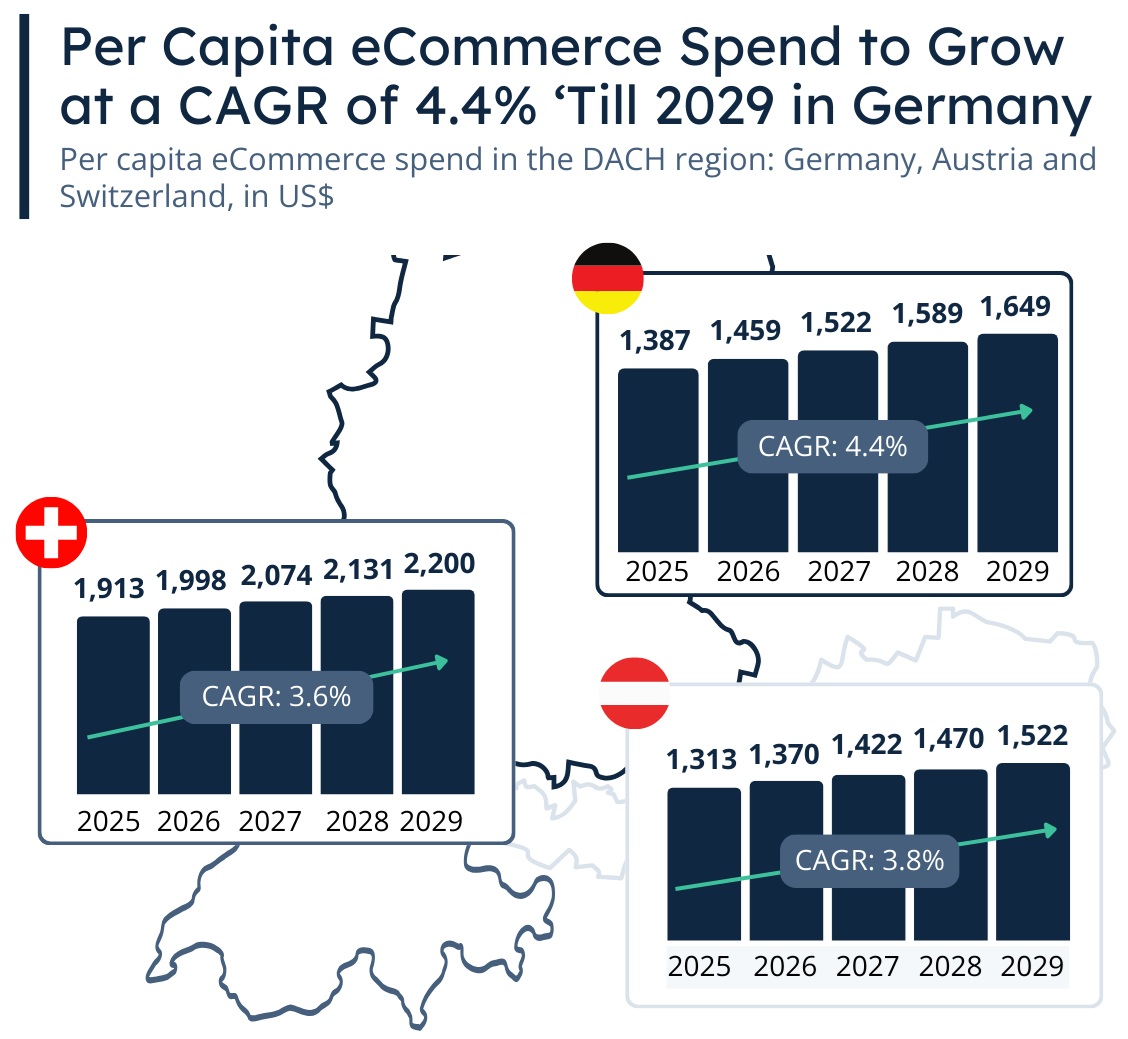
Per capita spending is projected to climb from $1,387 in 2025 to $1,649 by 2029, a compound annual growth rate (CAGR) of 4.4%.
This positions Germany at the top of the DACH region in terms of growth momentum, though in absolute spend it remains behind Switzerland.
The trajectory suggests a balanced market: expanding steadily from a high base, while contending with a declining population and slower overall growth compared with emerging e-commerce nations.
Switzerland: High Spending Power
In Switzerland, affluence and digital appetite combine to create one of the world’s strongest e-commerce markets per capita.
Average spend is expected to reach $1,913 in 2025 and $2,200 by 2029. This places Swiss consumers among the most valuable globally, close to peers in the US, UK and South Korea, where per capita online spending exceeds $2,000.
Interestingly, Switzerland’s CAGR for per capita spend, at 3.6%, is lower than Germany’s, reflecting the market’s maturity.
Yet the scale of individual expenditure highlights its attractiveness to international and domestic platforms.
Marketplaces such as Galaxus, Digitec, Amazon.de, Zalando and Ricardo illustrate the blend of global reach and local preference shaping Swiss online retail.
Austria: Following Germany’s Lead
Austria presents a different picture. Forecasts place its per capita spend at $1,313 in 2025, climbing to $1,522 by 2029. With a CAGR of 3.8%, Austria outpaces Switzerland in growth but remains firmly behind in spending levels.
The Austrian market is notable for its dependence on German-origin platforms, including Amazon.de, Otto and Zalando, as well as global entrants like Temu and eBay.
This close alignment with German consumer habits reduces Austria’s distinctiveness within the regional comparison. While growth is positive, Austria’s digital retail sector lacks the unique drivers evident in Switzerland.
Three Distinct Paths
Together, the three markets show diverging trajectories.
Germany provides scale and steady growth from a mature base; Switzerland demonstrates the spending power of affluent consumers; Austria delivers incremental progress but with heavy reliance on cross-border platforms.
For payment providers, merchants and investors, the lesson is clear: the DACH region cannot be treated as a uniform whole.
Each market demands its own strategy — whether addressing Germany’s vast but competitive consumer pool, Switzerland’s premium spending base, or Austria’s tightly linked, German-influenced ecosystem.





Comments