 trending








In a new Global Benchmark for Sustainable Banking report it examines the key trends, opportunities and challenges presented by the adoption of key emerging technologies such as cybersecurity technologies, machine learning (ML) and artificial intelligence (AI), mixed reality and digital wealth management technologies.
600 C-suite banking executives across the United States, United Kingdom, the Netherlands and Australia were surveyed.
In an era marked by relentless technological advancements, banks have embarked on a transformative journey, leveraging emerging technologies to restructure their operations and enhance customer experiences.
Metaverse failing to capture attention
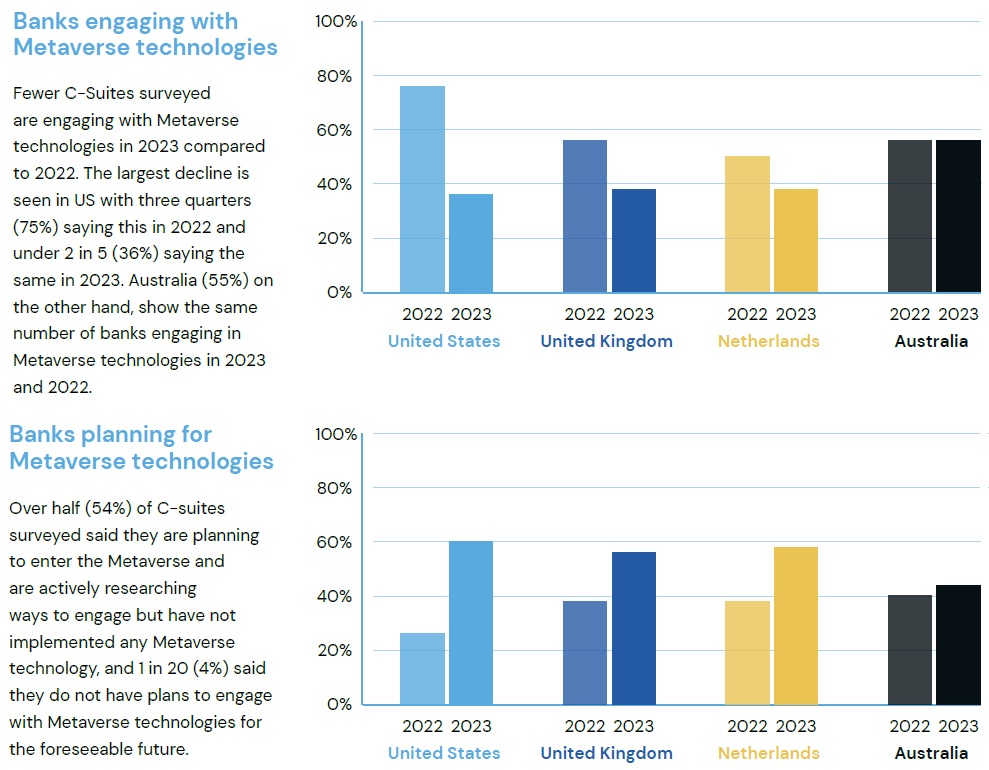
According to the report, 38% of UK banking executives are “engaging with metaverse technologies” this year compared with 56% last year.
The term metaverse was coined in Neal Stephenson‘s 1992 science fiction novel Snow Crash, where humans, as programmable avatars, interact with each other and software agents, in a three-dimensional virtual space that uses the metaphor of the real world.
More recently it was defined by Forrester as an immersive experience of interoperable and interlinked environments that will be delivered via a variety of devices.
According to its report, The state of the metaverse, it will be delivered in stages, building out to a decentralised platform that puts a 3D experience on top of the World Wide Web.
Management consultancy McKinsey & Company predicted the metaverse economy could reach $5 trillion by 2030.
But according to the Hexaware Mobiquity report, there was a more significant reduction in engagement with metaverse technology among executives in the US, where 75% were engaged with the metaverse in 2022 and just 36% this year.
In the Netherlands, banks also reduced their focus on the metaverse, with 38% engaging with the technology this year compared with 48% the year before.
In Australia, focus on the metaverse this year remained the same as last, with 55% of executives occupied with the technology.
Key focus
In the US, over a fifth (23%) of C-Suites surveyed in the US state cybersecurity technologies as their bank’s top focus – followed closely by embedded finance solutions (22%) and ML and AI (19%).
Furthermore, technology and sustainability are becoming increasingly intertwined as more importance is placed globally on being environmentally conscious and socially responsible.
This includes developing blockchain-based solutions and developing data visualisation tools, both of which US banking executives claimed as their preferred technologies to be used to support ESG and transparency in the banking sector.
“In an era with such rapid innovation, the successful, strategic integration of emerging technologies and digital tools will undoubtedly be a defining factor for banks seeking to maintain a competitive edge and improve operations,” said Peter-Jan van de Venn, VP Global Digital Banking at Hexaware Mobiquity.
“These technologies will play a critical role in reshaping customer experiences and operational strategies for years to come. By strategically embracing and leveraging these new advancements, banks will remain competitive while simultaneously unlocking entirely new avenues for growth and sustainable operations.”
Additional key findings:
- Machine learning (ML) and artificial intelligence (AI) is the second top emerging technology globally (20%).
- ChatGPT, extended reality (XR): augmented reality (AR) and virtual reality (VR), digital wealth management technologies, big data technologies, and metaverse technologies are all tied as the third top emerging technology globally (19%).
- One in six (16%) banking executives said their bank is engaging with embedded finance solutions, and the same percentage (16%) said their bank is engaging with open banking APIs.



Comments