 trending











Alipay has partnered with augmented reality (AR) pioneer Rokid to enable hands-free, in-store payments via smart glasses – a breakthrough that could reshape how consumers transact in physical environments.
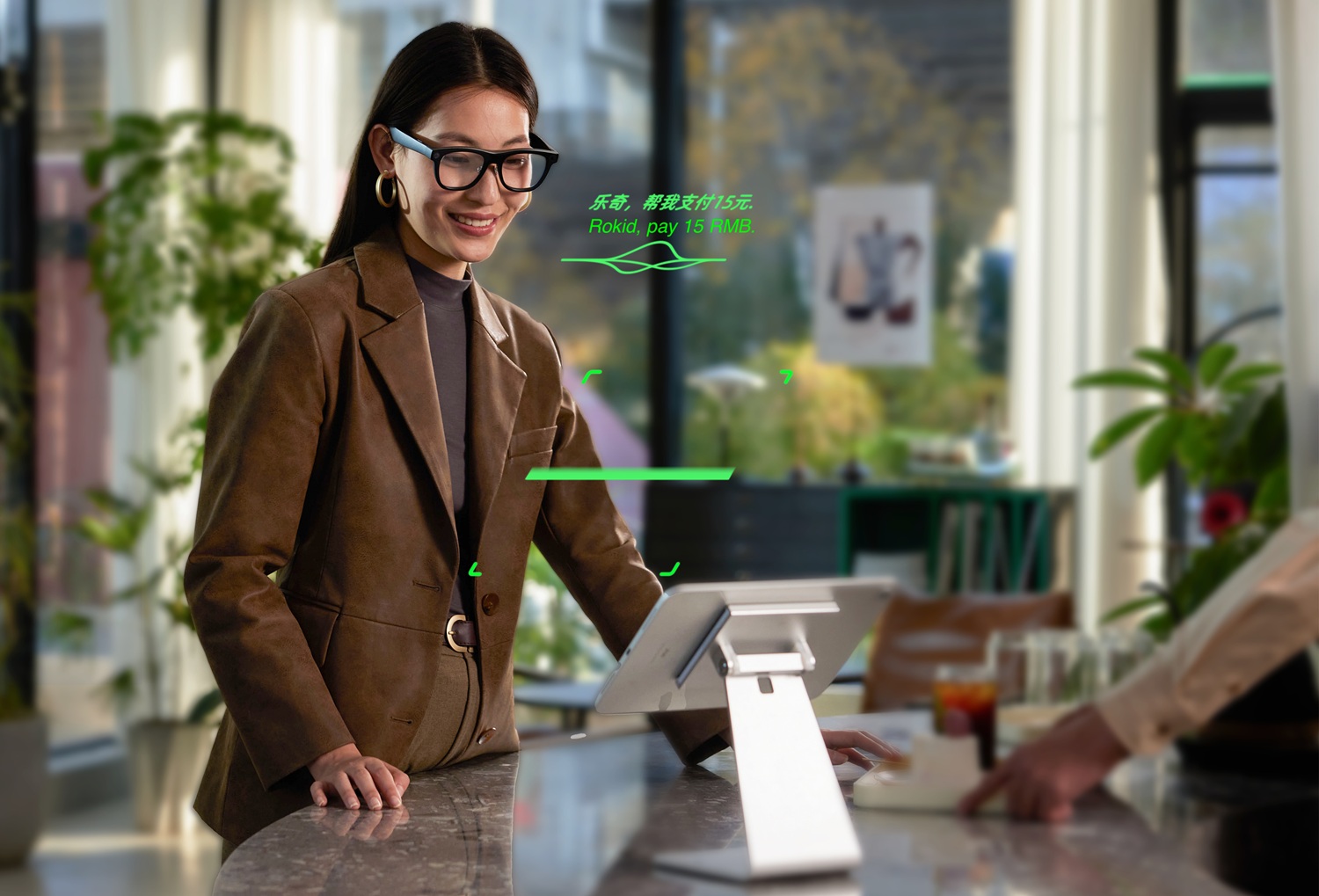
AR glasses with in-store payment capabilities
The newly launched Rokid Glasses, already boasting over 250,000 units ordered ahead of their June 2025 rollout, come fully integrated with Alipay’s digital payment infrastructure and multidimensional risk control systems.
This marks a significant stride toward a more immersive and frictionless future of commerce, where payments can be triggered by a simple voice command.
Shoppers wearing the glasses can initiate transactions by stating a phrase like “Rokid, pay 10 RMB,” prompting the device to scan a merchant’s Alipay QR code and present transaction details via the visual display.
Voice confirmation completes the process – eliminating the need to reach for a phone or wallet.
The result is a dramatically faster checkout experience: transactions via AR glasses can be finalised in mere seconds, compared with the 20–30 seconds typically required for mobile-based QR payments.
The added convenience of hands-free operation makes this particularly attractive for on-the-go consumers, as well as in high-traffic retail settings.
Rokid’s CEO, Zhu Mingming, sees the launch as a pivotal moment for the AR wearables market: “This innovation brings users a smoother and more intuitive experience, and sets a new benchmark for AI-integrated payment technology.”
For Alipay, this is the latest in a series of technological advancements.
The firm’s Tap! initiative – launched in 2024 and already adopted by over 100 million users – allows payments through physical tapping, bypassing apps and screens entirely.
Now, with AR glasses entering the payment ecosystem, Alipay is extending its vision of borderless, app-free commerce.
Beyond payments, AR wearables could unlock new dimensions of customer engagement.
Future iterations may support gesture-based purchases, virtual product interactions, and real-time personalisation – creating opportunities for merchants to deliver highly immersive, location-aware experiences.
As AR technology matures, the convergence of spatial computing and digital payments promises not just greater convenience, but a redefinition of what it means to shop in the physical world.





Comments