 trending









How much do I earn or lose as an acquirer from a specific merchant? How does the financial impact of launching a card product align with initial forecasts and expectations?
These are crucial questions for card transaction profitability, yet many do not know the exact answers – writes Kirill Lisitsyn, CEO & Сo-Founder at Torus.

Card transaction profitability analytics
The complex structure of costs and fees from card networks like Visa and Mastercard complicates understanding.
The card payments market is growing at double-digit rates each year, with thousands of new fees emerging.
As a result, FIs often manage efficiency only at the portfolio level and have rough estimates of the profitability and LTV (Lifetime Value) of their merchants and products.
This makes it difficult to make informed decisions to improve business performance. To address this, detailed analytics of card transactions must be implemented, which can be done in-house or by purchasing a ready-made solution.
The choice to develop an analytics service in-house, buy a ready-made solution, or improve operational-level analytics depends on business goals. This material examines the pros and cons of each approach based on our experience.
If your company’s policy allows for the sharing of anonymized data beyond the internal perimeter, this material may be useful. Otherwise, your only option will be to develop your own service.
Historical background: why not all financial institutions efficiently manage card transactions
First — use of outdated “portfolio analytics” methodology
If we look back to 15-20 years ago, fees for merchants and cardholders were often high, and many did not delve into the details of calculations. Revenue from any product seemed substantial, creating an illusion of stability.
However, as competition grew, some players began to engage in price undercutting, which led to a decline in margins. At the same time, expenses, particularly related to scheme fees, continually increased, making the line between profitability and unprofitability very thin.
Every 0.01% of commission can significantly impact the final results. Yet, analysis methods remained the same, and companies may overlook “bleeding” areas that require attention, especially with large volumes.
Second — constant emergence of new components of scheme fees
The largest card networks (aka schemes), such as Visa and Mastercard, were initially associations without direct commercial interests, with boards composed of executives from major FIs.
Over time, as they transformed into commercial entities, the focus shifted to financial sustainability and revenue growth.
This, in turn, led to the introduction of new services and increased complexity in pricing policies, adding details to transaction business calculations.
However, there is often not enough opportunity to train employees on these rapidly changing nuances.
Thus, scheme fees become a “black box” for market players. To remain competitive in terms of fee costs while also being profitable, it is essential to maintain strict and thorough control over profit and loss items.
Why analyse card transaction profitability
1) For acquirers: control money flows and identify unprofitable merchants
Merchants can become unprofitable for various reasons, such as unaccounted cross-border tariffs or unfixed fees on small transactions. Detailed analytics allow for identifying these issues at the merchant level, as such specific concerns may go unnoticed at the portfolio level.
2) For acquirers: forecast merchant profitability
It’s essential to know the most profitable rate when onboarding. Identifying which types of merchants yield what profitability and having a “calculator” for payment system fees is crucial. By consolidating volumes and types of merchants and studying the logic of interchange and scheme fee calculations, as well as how interchange++ works, acquirers can set more accurate fees for new businesses. This helps maximize revenue for both financial institutions and merchants.
3) For issuers: analyse profitability of card products
Similar to acquiring, scheme fees in issuance become more noticeable against the backdrop of declining margins. Transactions can be studied from various angles to provide a realistic view of revenue: by merchant types, transaction types, MCC, at the card level, and by user segments.
4) For issuers: forecast profitability of new products
Based on preliminary results from issued card products, it’s possible to estimate how quickly they will become profitable across different segments. This allows financial institutions to assess the viability of introducing new offerings in advance.
5) For everyone: optimise invoices
Invoice analysis helps identify new fees, including those for services. Optimising invoices through a user-friendly interface can save up to 10% of the total amount.
Solution 1: Develop In-House
Pros: technological security and full control over the process
1) Deep involvement in company processes. Your team has access to all data and the ability to communicate closely with relevant specialists and databases. This allows for experimentation with various internal integrations.
2) Team control. You are not dependent on the skills of an external team, which may impose data format requirements or limit development capabilities.
3) Peace of mind regarding sensitive data. Quality analytics require extensive data, often protected by NDAs. There is a concern that sharing data containing profitability leaks could negatively impact the company’s reputation.
4) Technological security. All knowledge about the product remains within the company, providing protection against hacks and technical attacks. Sometimes, direct prohibitions on using external software are detailed in security documents, making the need for an internal solution evident.
Cons: requires significant man-hours, expertise, and money
1) Need for rare specialists. Creating such a product requires a rare specialist who combines knowledge of commission economics and technical aspects of transactions. For example, one transaction can involve over 10 fees, and it is essential to understand which fields and attributes influence the calculation of each component of the scheme fee.
2) Time and money. Expect 1-1.5 years (or even more) of development with a team of up to ten people. The costs for creating and maintaining such a tool within a financial institution can reach significant amounts with six zeros annually.
3) Lack of external experience. When developing a product in-house, you are limited by your team’s experience and may overlook all analytical opportunities. This can lead to creating an MVP that is difficult to develop further.
4) Complex product support. Continuous technological improvement of pricing calculators is necessary to keep up with changes in payment system rates. This is especially important for card businesses in different jurisdictions, as payment systems change fees at different times for various countries. Constant monitoring of announcements from payment systems and timely integration of updates is required.
Curious fact #1: If a company designates a person for card transaction analytics, an additional tool is provided only 1 out of 5 times. Meanwhile, up to 70% of the total analytics process time is spent on technical setup in Excel. As a result, this distribution of hours significantly reduces efficiency, leaving little time for core tasks.
Solution 2: Purchase a Ready-Made Analytics Service
An external service for analysing the profitability of card transactions can be cloud-based or software-based. Each option has its nuances, but let’s examine the pros and cons of external services in general.
Pros of external services:
1) Quick impact. You receive a ready-made tool with current settings and can immediately identify revenue “leaks.”
2) Cost-effective. The cost of an external analytics solution typically equals the annual salary of one senior-level FTE developer, while in-house development might require 5 to 10 times that amount with uncertain results.
3) Timely model updates. An external solution is backed by a team that monitors updates and continuously improves the product, as this is their primary focus.
4) Continuous product development. New features emerge from the broad usage by many clients worldwide. For example, one of our recent developments arose from community feedback — the “what if” analysis feature, which helps assess how changes in card network fees affect merchant profitability.
Cons:
1) Data security concerns. There may be worries about data security and the accuracy of calculations, especially if the company has not established a reputation for reliability.
2) Sensitive information disclosure. There can be discomfort in having outside specialists access information about the bank’s revenues and expenses.
3) Dependence on external factors. The provider’s shutdown or possible service interruptions can lead to problems with the service and support team.
Solution 3: Count Manually in Excel, Without Using Any Special Programs
One might wonder: “Why should our company invest in a separate product for analysing the profitability of card transactions if we can calculate everything well ourselves?”
Indeed, most companies perform some form of analysis. Let’s look at how this is done in 70% of financial institutions.
Human resources:
Full-time payment systems analyst.
Such a person is rarely available, and analytics tasks are performed by an employee who combines them with other duties. It’s important to consider the human factor: the frequency of errors is higher than in software solutions.
Specialist tracking fee updates in card networks.
Typically, there is no one dedicated to studying invoices, scheme fees, and other aspects. As a result, the quality of companies’ calculations can lag behind current data by six months or even several years. While companies know their fees well, they often fail to keep up with changes.
Methods of calculation:
Calculations often take place in Excel, with the level of detail available depending on the specialist’s knowledge of formulas. This usually results in a rough analysis at the portfolio level.
Operational activity:
Data checks occur once a month at best. This is optimal if there is an analytical program and confidence in the absence of hidden revenue leaks. In such cases, preventive checks once a month are typically sufficient.
Curious fact #2: If a financial institution has a dedicated specialist studying data flows and monitoring updates from card networks, it may seem that they can be easily replaced in case of resignation. However, such specialists are extremely rare in the market. We have observed several cases in the CEE (Central and Eastern Europe) region where the departure of such a specialist led to a significant decrease in efficiency in transaction business costs.
Conclusions
Everything suggests that FIs would like to have their own analytical product. There are indeed companies – usually 1-2 per market – that have succeeded, and these are very large players. Most often, these are companies that initially embedded a tech-centric approach and a focus on digital solutions in their business policy, allowing their internal product to evolve alongside external commercial solutions from the very beginning.
In practice, however, the “manual mode” analytics available in most FIs only allows profitability to be analyzed at the portfolio level, without the ability to identify specific unprofitable merchants. Furthermore, it is rare to have a department or individual who can fully dedicate their time to market analysis and analytics.
If this situation sounds familiar, it may be time to consider either an in-house or external analytical product that can help preserve up to 50% of net profit, the leakage of which is currently unnoticed.
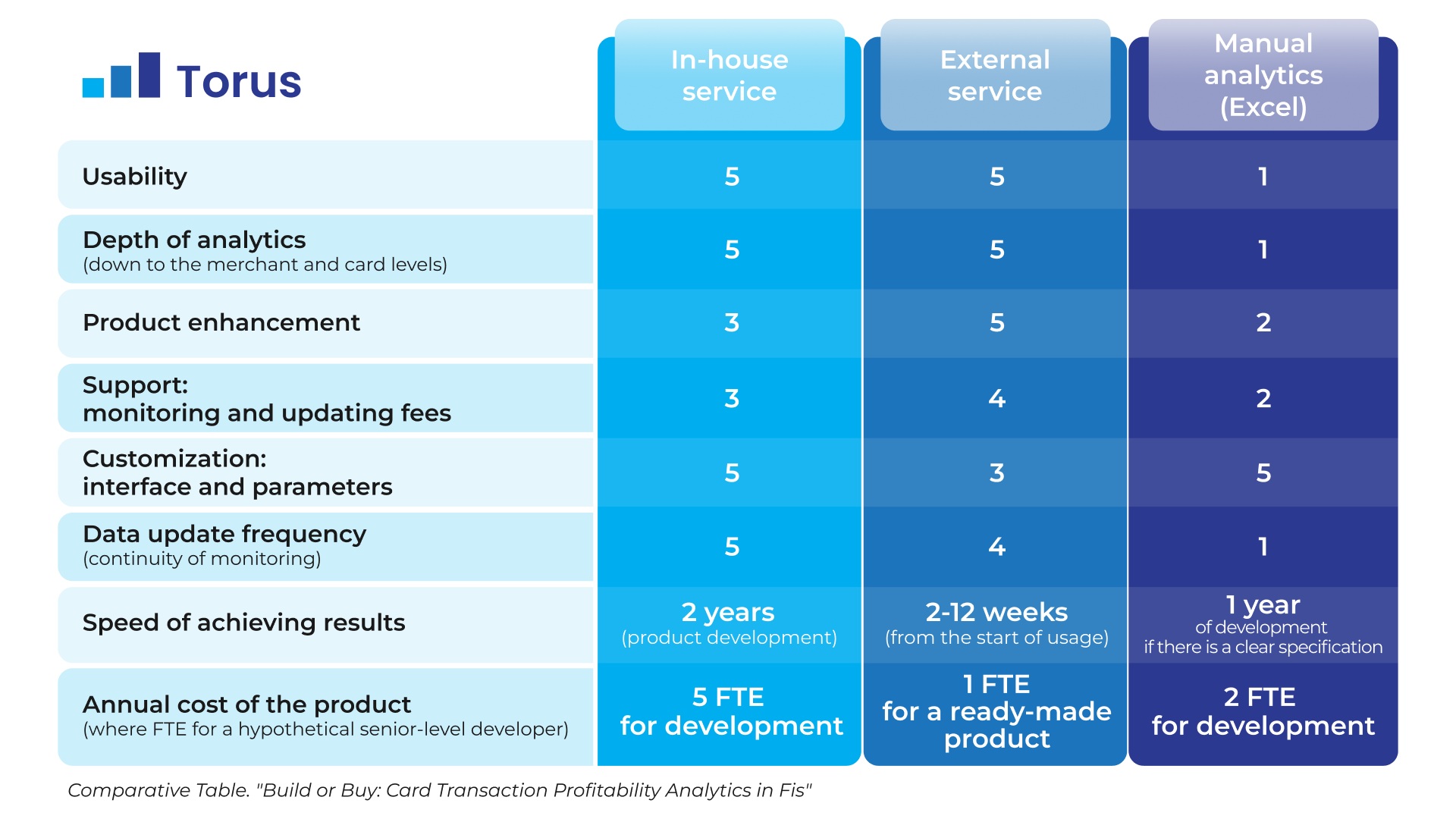
Comparative Table
Below you will find a brief comparison of parameters. Most evaluations are on a scoring scale, where 1 is very low and 5 is the highest.
*Kirill Lisitsyn is CEO & Сo-Founder at Torus. Kirill has over 15 years of consulting experience with companies like Accenture and Mastercard, serving banks and financial services. He co-founded Torus to enhance transparency in card payment profitability control for mid-market players. Torus is an award-winning SaaS intelligence platform that helps banks and fintechs boost profits on card transactions, enabling issuers and acquirers to optimize fees and improve earnings through detailed profitability analysis. Kirill is a frequent speaker at industry events, sharing insights on payments and financial technology.



Comments