 trending










Global payments are standing at a structural turning point. For decades, the movement of money across borders has been defined by legacy rails such as SWIFT messaging, prefunded accounts, and centralised netting.
These infrastructures ensured stability but at the cost of speed, transparency, and capital efficiency. Now a new alternative is now emerging: stablecoins, combining the stability of fiat currencies with the programmability of blockchain.
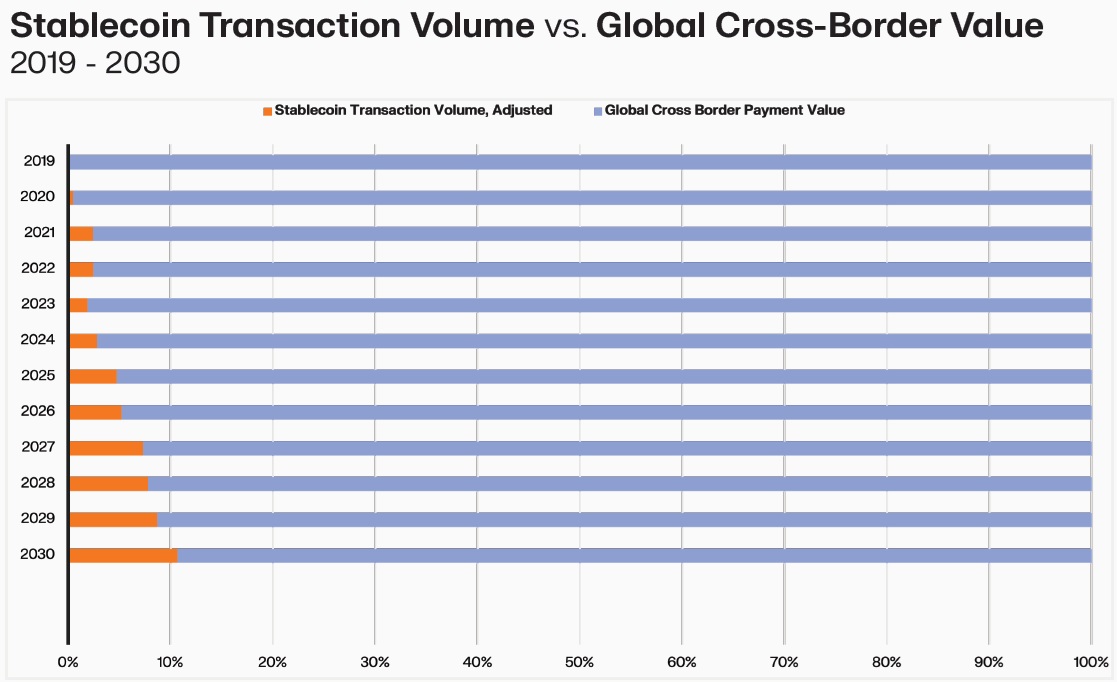
According to new research by Keyrock and Bitso, stablecoins could capture 12% of all cross-border flows by 2030, moving the equivalent of $1 in every $8 sent globally.
That trajectory would make stablecoins one of the most consequential innovations in financial infrastructure since the creation of SWIFT in the 1970s.
Why the Legacy System Falls Short
Today’s cross-border payment process is riddled with inefficiencies.
SWIFT only transmits instructions rather than funds, meaning transactions pass through multiple correspondent banks, each conducting compliance checks and adding fees.
To accelerate settlements, providers rely on prefunding—parking billions of dollars in dormant nostro accounts abroad.
The Bank for International Settlements estimates more than $27 trillion is immobilised this way, creating a drain on liquidity and yielding negligible returns.
Netting reduces some of these burdens but introduces its own delays and risks, relying on end-of-day batch processes that can leave counterparties exposed.
Emerging markets suffer most from this architecture, often facing processing times up to five days and transaction costs several times higher than those in developed economies.
How Stablecoins Collapse the Stack
Stablecoins offer an elegant response: they merge messaging and settlement into one programmable layer.
By transferring tokens directly onchain, value moves in seconds with end-to-end transparency.
Unlike correspondent banking, stablecoins don’t require prefunding; liquidity can be drawn and repaid dynamically.
The so-called “stablecoin sandwich” illustrates this model: a sender converts local currency into a stablecoin, transfers it globally via blockchain, and the recipient cashes out in local fiat.
Firms such as BVNK have gone further by offering virtual USD accounts backed by stablecoins, enabling SMEs worldwide to access dollar clearing without opening a US bank account.
This has profound implications for capital efficiency.
Platforms like MANSA and Arf show that on-demand stablecoin liquidity can turn over 10–50 times annually, compared with the 1–2x rates typical in legacy money transfer operators.
Proof in the Payments
While stablecoins originated as trading tools within crypto markets, their role in real-world payments is accelerating.
Between 2023 and early 2025, monthly B2B stablecoin flows grew more than 2,400%, reaching $2.7 billion, while card-based payments rose to nearly $1.1 billion.
Remittance use cases are also gaining traction: firms such as Bitso and Sling Money are enabling Latin American and Southeast Asian workers to send funds at a fraction of the 6–12% fees charged by banks.
These examples point to a $1 trillion annual opportunity by the end of the decade, with stablecoins penetrating sectors from corporate treasury to consumer spending.
Strategic Implications
The expansion of stablecoins goes beyond cost savings.
By allowing programmable settlement, they transform money into software. Smart contracts can automate supplier payments, enforce compliance checks, or even stream salaries in real time.
In foreign exchange, onchain FX promises atomic, real-time swaps across currencies, eliminating the need for correspondent banks and T+2 settlement.
The macroeconomic consequences are equally significant.
If stablecoins grow to a $2 trillion supply, as projected, they could hold close to a quarter of the US Treasury bill market—ranking issuers among the largest global holders of government debt.
This would give them an active role in shaping monetary policy transmission and front-end yields.
The Road Ahead: Regulation and Scale
For stablecoins to achieve systemic relevance, regulatory clarity is essential.
The US CLARITY and GENIUS Acts, signed into law in 2025, are early attempts to define stablecoins as permitted payment instruments rather than securities. These frameworks are expected to catalyse further adoption by removing legal uncertainty for banks, fintechs, and corporates.
At the same time, liquidity, interoperability, and “last-mile” connectivity into local fiat systems remain challenges.
Without deep pools and robust off-ramps, stablecoins cannot fully rival the ubiquity of bank networks.
Yet progress is rapid: regional stablecoins are proliferating, liquidity is deepening across pairs, and major fintechs are integrating stablecoin infrastructure as a core feature of their offerings.
Speculative Niche or Mainstream Rail?
Stablecoins are no longer a speculative niche—they are becoming a mainstream payment rail.
By 2030, they could account for more than one-tenth of all cross-border flows, reshaping how businesses manage treasury, how families send remittances, and how policymakers think about liquidity.
The trillion-dollar opportunity ahead is not simply about moving money faster.
It is about re-architecting the very infrastructure of global finance—collapsing layers of friction into programmable, universal rails.
For institutions, fintechs, and regulators alike, the choice is now less about whether to adopt stablecoins and more about how quickly they can adapt to a system where value moves like information: instantly, transparently, and without borders.



Comments