 trending










Africa is predicted to become the world’s fastest-growing continent when it comes to fintech revenue, with a compound annual growth rate (CAGR) of 32%.
This means that by 2030, the African fintech market will be worth around $65 billion, according to a report by Boston Consulting Group (BCG).
The report found that South Africa, Nigeria, Kenya and Egypt lead the fintech race in Africa. This is partly due to a lack of legacy infrastructure holding these countries back from exploring new financial ecosystems to serve underbanked and unbanked citizens.
Just under 500 million people in Africa are unbanked, whereas just over 410 million are underbanked.
“Fintech could be the vehicle to solve the access issue, with smartphones presenting major opportunities in payments and lending for regional champions with full-stack attacker models,” explains Caio Anteghini, partner at BCG.
“Globally and in Africa, the fintech journey is still in its early stages and will continue to revolutionise the financial services industry as we know it,” he adds.
Global expectations
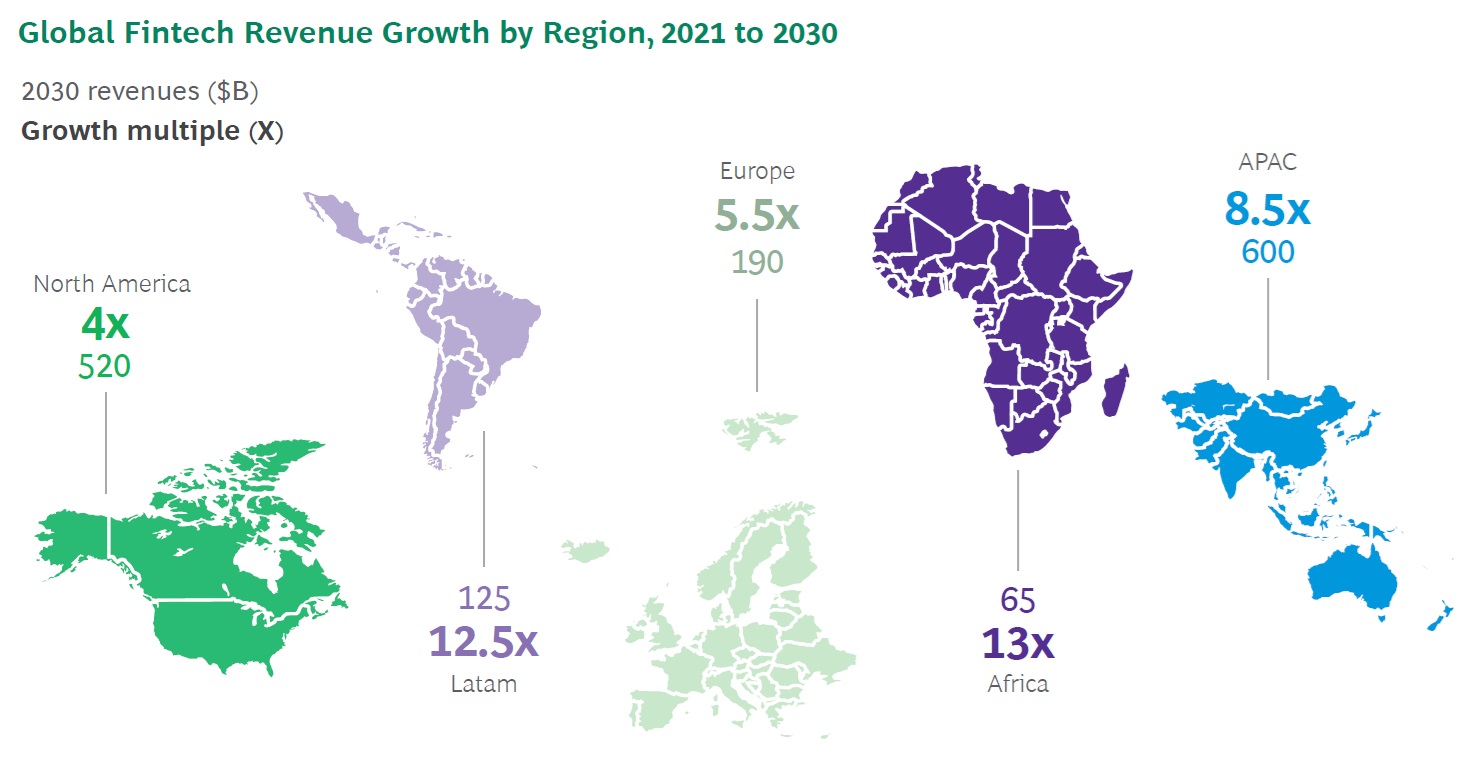
Africa is currently winning the growth race for fintech, with a predicted 13 times growth to be achieved by 2030.
The continent is followed by Latin America, with a 12.5 times growth rate. Asia-Pacific is expected to grow by 8.5 times and Europe by 5.5 times.
By 2030, North America is expected to grow by four times.
However, these are growth rates, not overall revenue value.
While Africa’s fintech market is expected to be worth $65 billion by 2030, this is the smallest value of all. The Latin America fintech market is expected to be worth $125 billion; the European market will be $190 billion; the North American market will be $500 billion and the Asia-Pacific market will top $600 billion by 2030.
Why Africa?
Globally, financial services is one of the most profitable sectors, but it struggles with innovation and customer satisfaction.
African companies have seized the opportunity to plug holes in the market through innovative fintech services that provide some financial freedom to local users. Mobile money services are a common trend among African telcos.
In addition to telcos joining the financial services sector, many banks have also launched fintech services to retain market share and accelerate their own digital journeys. Even in South Africa, some banks offer points-based reward systems or digital currencies of their own.
“In Africa, although cash is still king, fintech could be a vehicle to solve the access issue, as most of the population is still either underserved by banks or fully unbanked. As the youngest and fastest-growing region globally – with a median age of roughly 19 and projected population growth of an additional 1.2 billion people by 2050 – demographic shifts and earning-power increases will deepen the need for financial access,” reads the report.
“Most Africans’ first interaction with the financial services sector may be through their smartphones – presenting major fintech opportunities in payments and lending…” continues the report. This can already be seen with telcos and their fintech offerings that have spurred on growth in the African sector.
The future of fintech services
Currently, payments are the largest fintech segment and the cause of the initial growth. Payments are likely to remain the biggest use of fintech until 2030, but business-to-business-to-any-user (B2B2X) and B2B services may become the next big thing for the market.
B2B2X is a new business model in which a telco delivers financial services to its end-users.
The idea is to combine telecoms and IT services with applications used by companies to offer services to their customers, retailers, partners, suppliers or whoever might make up the “X”.
It’s set to be an emerging business model that relies on fintech.
Currently, B2B fintech revenue is projected to grow at a 32% CAGR until 2030.
With roughly 400 million small-to-medium-sized enterprises (SMEs) globally, hundreds of millions of small business owners could benefit from joining the fintech revolution and unlock financial benefits for their companies.
In Africa, SMEs provide 80% of all jobs, so the opportunity for growth in the fintech space is massive.



Comments