 trending









Following the launch of the second euro banknote series – the Europa series – the ECB started to assess the environmental impact of euro banknotes as a means of payment with a new study.
This study is based on the European Commission’s Product Environmental Footprint (PEF) methodology.
Background
Cash is the most frequently used form of payment by Europeans at the point of sale (POS).
For this reason, an adequate cash cycle infrastructure must be in place, with a sufficient distribution system allowing people and businesses to access cash through the automated teller machine (ATM) network, bank branches and other cash access points.
Europeans need their cash to be accepted by retailers, while retailers need a proper infrastructure in place to be able to deposit the cash they receive.
Many other aspects must be considered in addition to a well-functioning infrastructure to ensure trust and a viable euro banknote cash cycle, such as the quality and security of the banknotes.
Environmental, health and safety aspects should also be taken into consideration to make sure that the banknotes are safe to use and do not have a negative impact on the environment.
The environmental aspects of euro banknotes and the cash cycle have not only been a priority for the Eurosystem since the launch of the euro in 2002 but are also a key element of its cash strategy.
Efforts have continued, and will continue, to reduce the environmental impact of euro banknotes.
The aims of PEF study:
- Achieve a comprehensive knowledge of the potential environmental impact of all the activities of a full cash cycle of banknotes, from raw material acquisition and manufacturing to the disposal of euro banknotes.
- Measure the potential environmental impact of banknotes as a payment instrument, to help further identify aspects in the banknote life cycle that can be targeted to reduce the environmental footprint of euro banknotes.
This PEF study finds that the single overall score for the average annual value of cash payments per euro area citizen (EAC) in 2019 is 101 micropoints (µPt).
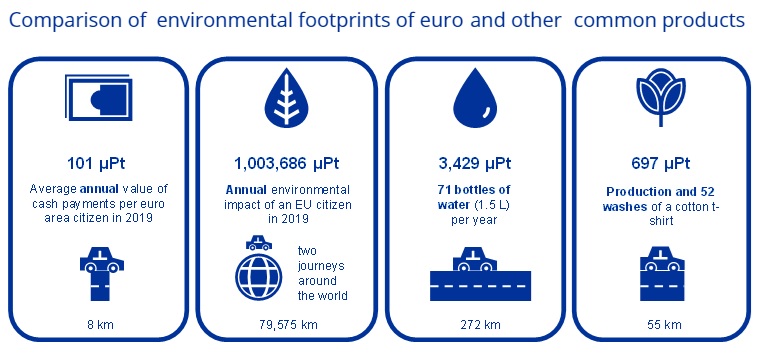
This very low score is equivalent to an EAC driving a standard car for 8 km, or to 0.01% of the total environmental impact of a European’s annual consumption of activities.
To further illustrate this point, it is worth comparing the results of the annual value of euro banknote payments with those of other everyday products, such as the production of a cotton T-shirt that is washed once a week for a year (comparable to driving 55 km).
Or the manufactured bottles of water consumed by an EAC in one year (equivalent to driving 272 km), as illustrated in the figure below.
The main activities contributing to the environmental footprint of euro banknotes are the powering of ATMs (37%), transportation (35%), processing activities in the distribution stage (10%), paper manufacturing (9%) and the authentication of banknotes at the point of sale (POS) in the use stage (5%).
Since 2004, efforts have been made to reduce the environmental footprint of euro banknotes.
For example, the Eurosystem has imposed a landfill ban on banknote waste and implemented initiatives like the Sustainable Cotton Programme.
In addition, significant efforts have been made by ATM manufacturers and credit institutions to reduce their environmental impact.
The study shows that improvements in the energy efficiency of ATMs contributed to a 35% decrease in the single overall score of the cash cycle between 2004 and 2019.
Moreover, in addition to transport optimisation, other ways to reduce the environmental impact of transportation and use more sustainable fuels are being considered.
Even though the environmental impact of paying with euro banknotes is overall very low, the Eurosystem is committed to reducing it further.
It is conducting extensive research and development to achieve this, while ensuring that cash is widely available to the public.
This work will feed into the development of our future series of euro banknotes with a view to make them as environmentally friendly as possible.
Similar or partial studies will also be carried out by the Eurosystem, in particular when a significant change has occurred in the cash cycle.





Comments