 trending








The financial services industry is experiencing volatility spurred by ongoing inflation, interest rate hikes and recovering stock markets.
To address these market dynamics and maintain business growth financial firms are strategically embracing digital transformation.
Adopting cloud enabled solutions during their transformation is now becoming essential to gaining a competitive advantage.
It’s not about cloud but cloud enabled business growth
More than 80% of financial services industry executives surveyed for the World Cloud Report – Financial Services, agree that firms can overcome business challenges and unleash growth through superior customer experience and operational excellence.
And the right platform is critical for scalability, flexibility, productivity, innovation and agility required to meet industry and customer demands.
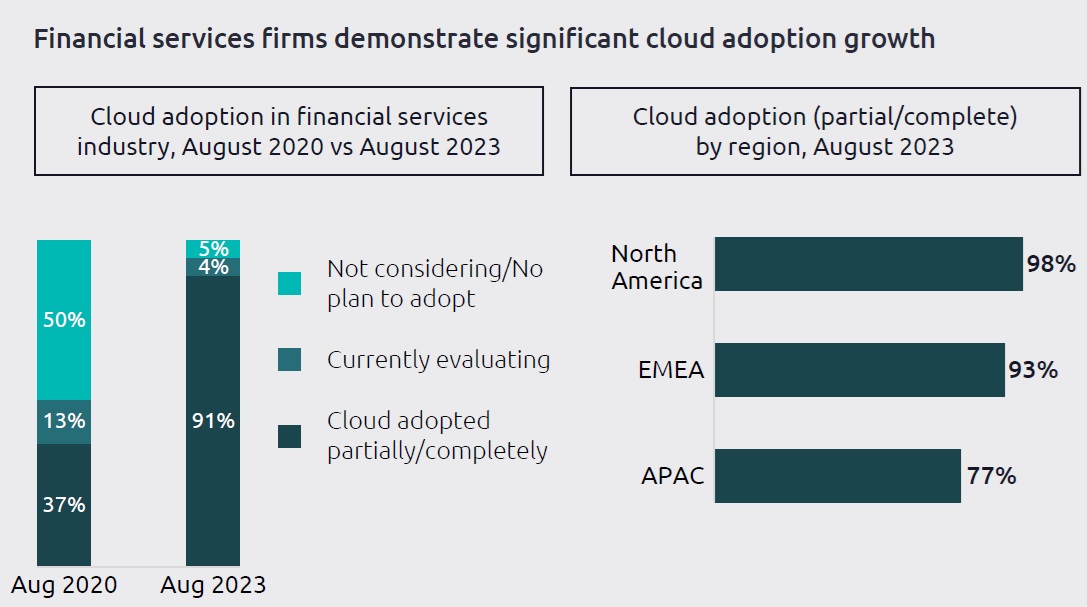
Cloud as an enabler is catalysing growth for financial services firms, as 91% of respondents indicated.
New age players essentially born in the cloud leveraged this competitive advantage to fuel their initial successes and win customer mindshare.
Now incumbent banks and insurers are fully engaged in their own cloud journeys. Across the financial sector cloud migration has risen significantly from 37% in August 2020 to 91% in August 2023.
While non core applications have most definitely experienced a cloud migration upsurge, many firms have not moved a considerable portion of their core applications to a cloud computing environment.
Instead, many opt for a “lift and shift” model that can hinder cloud based systems’ full scalability and flexibility advantages.
Composable platforms are instrumental to business needs
 A composable platform will help financial services firms redefine processes, move to cloud and integrate cloud enabled, customer facing applications and core back end functionality: operational impact and improve customer satisfaction will be the result.
This platform approach leverages prebuilt components spread across layers over a legacy or cloud enabled core engine.
This helps to increase flexibility, improve digital collaboration/integration, enhance scalability through modular mechanisms, realise cost efficiency and enrich customer experience.
A phased approach helps firms successfully add platform components and prioritise functionalities for cloud migration – while risk management functions are a priority for banks, policy servicing and management and customer relationship management are essential for insurers.
However as financial services functionality is transformed some firms will face challenges around data and cost overruns during cloud migration.
An effective cloud migration road map creates business value
A comprehensive cloud strategy and road map are critical to overcoming cloud migration challenges and enabling business growth for financial services companies.
As a first step consider an end to end phased approach to digital transformation in financial services this starts by prioritising the key businesses and adoption areas.
Next it is essential to create and then implement a path for cloud modernization enablement and implementation.
And finally understanding and taking full advantage of cloud enabled systems to deliver the best customer experience is essential.
Nearly half of the financial services executives polled across domains said operational productivity is imperative for strategic business growth, while 40% of them also considered customer satisfaction as an integral pillar driving the growth plan.
In line with these business priorities, cloud migration functionalities being prioritised by firms include risk and customer relationship management areas.
Once firms identify these areas, the next step is to define and implement an effective cloud target operating model – focusing on ROI, talent, API strategy, infrastructure, security, cloud providers and cloud partners.
Cleansing all data for accurate, appropriate, secure and timely input is also essential.
By implementing cloud at scale financial services firms can fully unlock their abilities to leverage new technologies such as generative AI.
A cloud enabled ecosystem will help provide competitive edge in an innovation powerful future.



Comments