 trending









One third (33%) of commercial payments clients are highly likely to switch to another provider if it offered more value-added services that enrich the payments experience, according to Accenture’s Commercial Payments Survey 2023.
The research found that, on average, clients are willing to pay 8.1% of their annual payments costs towards value-added services, which could represent $371 billion in value by 2028.
Examples of such services include fraud management tools, real-time data dashboards, automated bill payments, biometric payments and tax system integration.
The report revealed that banks and payments providers aren’t prioritizing these services and don’t think clients view them as differentiators, with six in ten (63%) of banking and payments execs stating that they view commercial payments merely as a cost centre.
However, clients surveyed said that the failure to receive value-added services was their second-biggest pain point, just behind weak fraud prevention.
Fintechs and bigtechs are making inroads
More than half (56%) of payments incumbents agree that competitive solutions from fintechs and bigtechs are diluting their share of wallet in commercial payments, according to the report.
Most incumbents (72%) said that it’s hard to compete with fintechs and bigtechs in merchant services, payment cards and cash management — areas where digital natives have quickly gained scale.
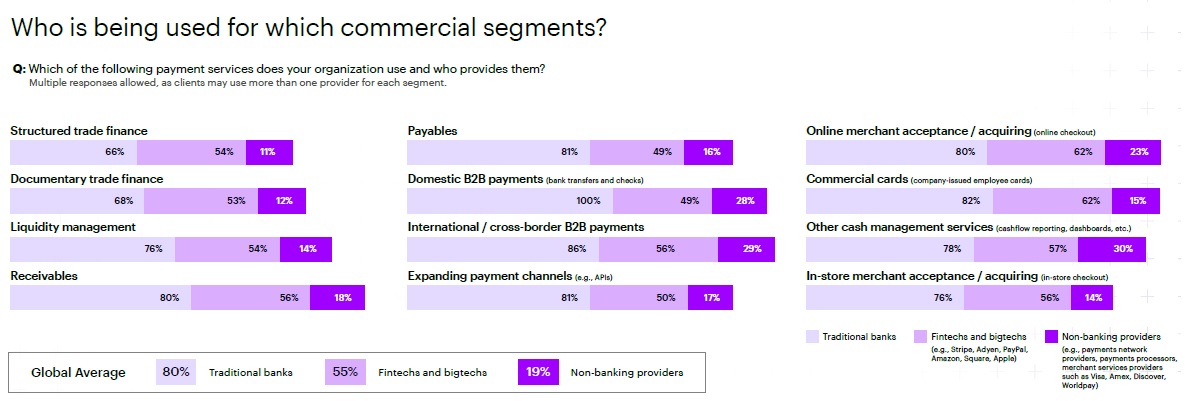
However, an overwhelming majority (92%) of corporate clients who said they were likely to move to a new provider would consider switching to a bank, while just 48% would consider switching to a fintech or bigtech.
This presents an opportunity for the incumbents to address clients’ common frustrations and transform payments into a platform for revenue growth, client retention and service innovation.
Legacy technology hampers innovation
The survey indicates that banks’ legacy technology is hindering their ability to innovate, with close to six in 10 (59%) banking and payments executives agreeing that their organization struggles with slow provisioning of new payments solutions due to a legacy tech stack.
The results suggest that most incumbents face an urgent need to modernize their commercial payment tech stack and build a ‘digital core’ to help develop innovative payments solutions leveraging cloud, AI and automation at pace.
Yet only 30% of banks have adopted high levels of automation and AI in their commercial payments division, while 43% have adopted cloud and 27% network connectivity to a high degree.
Adoption of Gen AI in payments nascent
Generative AI is still in its early stages of adoption among commercial payments providers surveyed, with only 13% stating that they have made significant investments in the technology.
However, most (85%) indicated that their organization will be at a disadvantage if it does not invest in it moving forward.
68% providers said they would develop generative AI solutions in partnership with other banks or fintechs. Among the early adopters that are implementing the technology in commercial payments, the top areas of investment are securing payments data, improved fraud detection and advanced credit scoring using synthetic datasets.
“Business-as-usual isn’t going to be enough for incumbent banking and payments providers to keep pace,” explains Sulabh Agarwal, Global Payments lead at Accenture.
“They need to commit to continuous, holistic reinvention if they are to defend market share from digital challengers.
Forward-thinking payments incumbents are using value-added services to differentiate themselves and take ownership of the entire commercial payments experience, from onboarding, invoicing and billing, all the way to reconciliation and fraud prevention.
Whichever routes they follow, successful companies will use their clients’ evolving needs as the blueprint.”




Comments