 trending









While UK consumers’ exposure to cybercrime has reduced over the past year, they experience more at cybercrime losses than any other major market in the world – despite being less susceptible to data compromise.
As the EU gears up to introduce one of the most stringent cybersecurity regimes anywhere, UK regulators will face the challenge of how to respond – or risk attracting even more crime.
Fight them on the breaches
A new survey from secure VPM provider Surfshark shows that – outside Russia, in which 8 out of 10 consumers suffer cybersecurity compromises – French consumers are the most likely to have their details stolen or compromised, with 3 in 10 consumers suffering compromises.
When it comes to loss events, however, UK consumers have the highest density of cybercrime events, with 841 loss events per 1 million internet users.
“Losses from cyber-crime in the UK remain ahead of peers like France and Germany.”
Surfshark report that UK loss events were cut by 9% over the last year, one of the fastest reductions in the world – yet remain higher than those seen in any other major market.
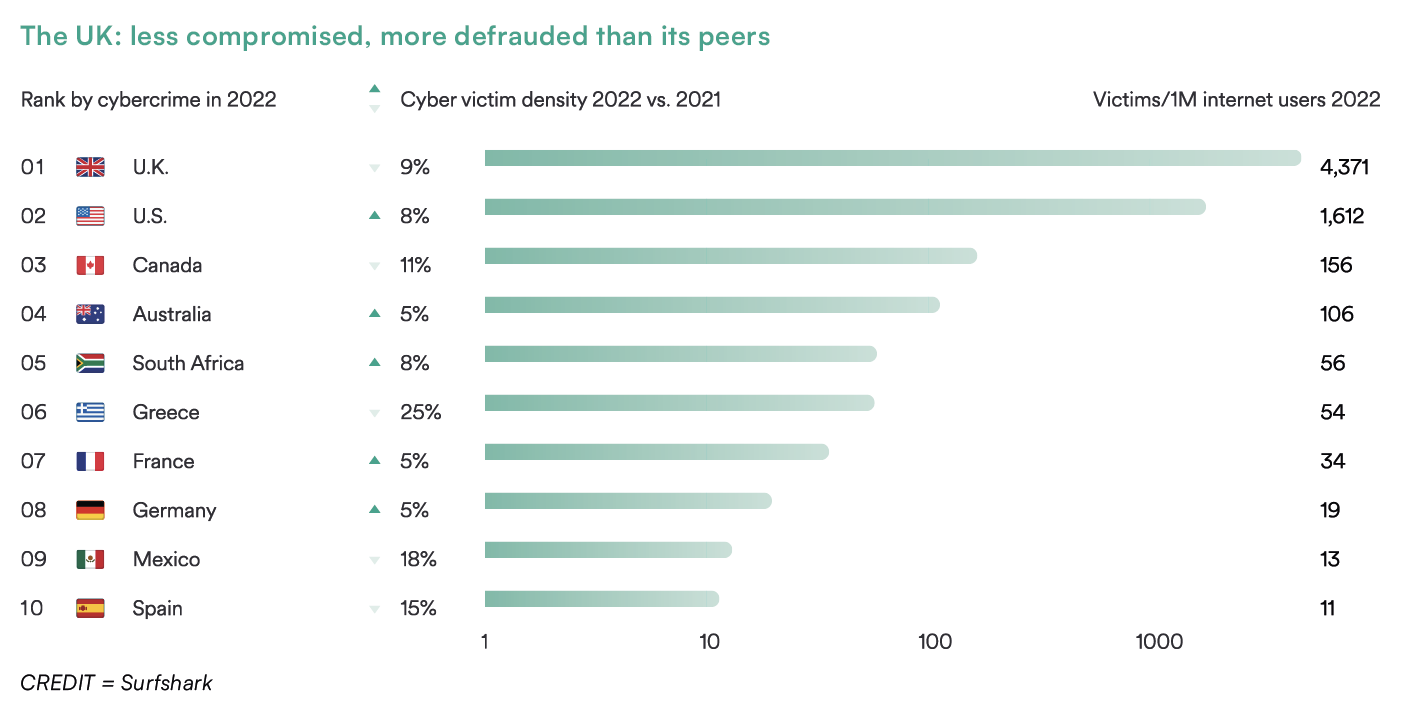
It will be argued that 841 losses per million, expressed as a percentage, amounts to a loss ratio below 0.084% – and yet this is still higher than in other leading markets such as the US, which saw an 8% increase in cyber losses, Canada and Australia.
One could further argue that the markets most frequently affected by cybersecurity related losses in the Surfshark study are among the richest in the world, and that criminals don’t bother trying to defraud those who live in poorer countries.
Acknowledging these important details, the fact remains that losses from cybercrime in the UK remain far ahead those experienced in peer markets such as France and Germany.
Payments Cards & Mobile says:
While there are good reasons to query the methodology behind Surfshark’s study, the general thrust of their findings – that more UK consumers suffer cybercrime than in other European markets – should cause concern in Whitehall.
That’s even more the case when one considers that in 18 months time the EU will begin to roll out its Digital Operational Resilience Act (DORA), designed to strengthen the resilience of the bloc’s financial institutions at a systemic level.
Given that the EU’s roll-outs are notoriously uneven and long-winded, there’s still time for the UK to get its act together.
But failure to do so will see even more cybercrime come the way of the UK – just as fraud migrated to the US 20 years ago when it tarried on the implementation of chip and PIN technologies…



Comments