trending








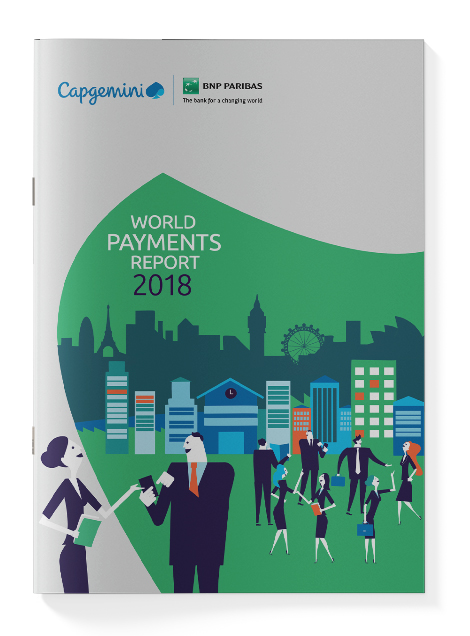 In this 14th edition, the World Payments Report (WPR) provides insightful analysis of the development of new payments ecosystems, which are opening new horizons in payments and transaction banking. In-depth analysis of global non-cash transaction volumes is combined with an examination of the everchanging regulatory landscape to track the evolution of payments ecosystems and payment service providers’ (PSPs’) changing roles.
WPR 2018 marks the third year of partnership between Capgemini and global banking institution BNP Paribas, a recognized leader in transaction banking and cash management. This partnership brings strategic insight and client-based industry research into the critical issues and trends shaping the payments industry that are relevant for corporate treasurers and financial institutions.
Globally, non-cash transaction volumes continued to grow at double digit growth rates during 2015–2016. Volumes grew by 10.1% to reach a total of 482.6 billion. The main growth regions during the period were Emerging Asia and Central Europe, Middle East, and Africa (CEMEA). Based on our model and hypotheses, we have also estimated the global non-cash transactions from 2017 through to 2021. WPR 2018 finds that the global e-wallet market is growing even faster, with transaction volume estimated to total 41.8 billion, which is about 8.6% of global non-cash transactions. Alibaba, Tencent, Google, Apple, Facebook, and Amazon have captured a significant share of this market. There is increasing evidence that high levels of non-cash transactions can benefit society in a number of ways and can even help to solve challenging problems, such as corruption and payments fraud.
Section 2 of the report analyzes the regulatory dynamics in the payments market. The section describes the cyclical effect that is being observed in the objectives of key regulatory and industry initiatives (KRIIs) between risk reduction, innovation, and standardization. It also examines how KRIIs with conflicting objectives impede the development of payment ecosystems and how regulatory clarification could help alleviate the challenges.
The core theme of the report explores how the banking industry is adopting new payments models to offer new value-added services to customers, including corporate treasurers. The report also analyzes the ways in which banks can come closer to their customers by orchestrating various services, leveraging emerging technologies, and suggests a roadmap for the future. In this edition of World Payments Report, we have introduced the Payments Open Banking Assessment. This highlights the state of open banking from a payments perspective across 16 countries. We highlight how an open banking environment successfully creates the conditions for non-cash payments, provided PSPs meet a few critical requirements, including adoption of emerging technologies, an innovative spirit, and collaboration with FinTechs.